Best Data Science Courses for Every Skill Level
If you’re looking for the best data science courses, the right choice depends on your current skills, career goal, budget, and the type of data science work you want to pursue. Beginners usually need a structured foundation in Python, statistics, SQL, and data analysis, while experienced learners may benefit more from machine learning, advanced analytics, and portfolio-focused programs.
The best course is not necessarily the longest or most expensive one. A practical course with strong projects and a clear learning path can be more useful than a program packed with theory but little hands-on work.
Best Data Science Courses
| Course | Best For | Skill Level | Main Strength |
|---|---|---|---|
| IBM Data Science Professional Certificate | Beginners | Beginner | Broad foundation |
| Google Advanced Data Analytics Certificate | Career-focused learners | Beginner–Intermediate | Practical analytics |
| DeepLearning.AI Machine Learning Specialization | Machine learning | Intermediate | ML fundamentals |
| HarvardX Data Science | Academic foundation | Intermediate | Statistics and theory |
| DataCamp Data Scientist Track | Hands-on learners | Beginner–Intermediate | Interactive practice |
| freeCodeCamp Data Analysis | Budget learners | Beginner | Free learning |
| MIT OpenCourseWare | Advanced learners | Intermediate–Advanced | Rigorous academic material |
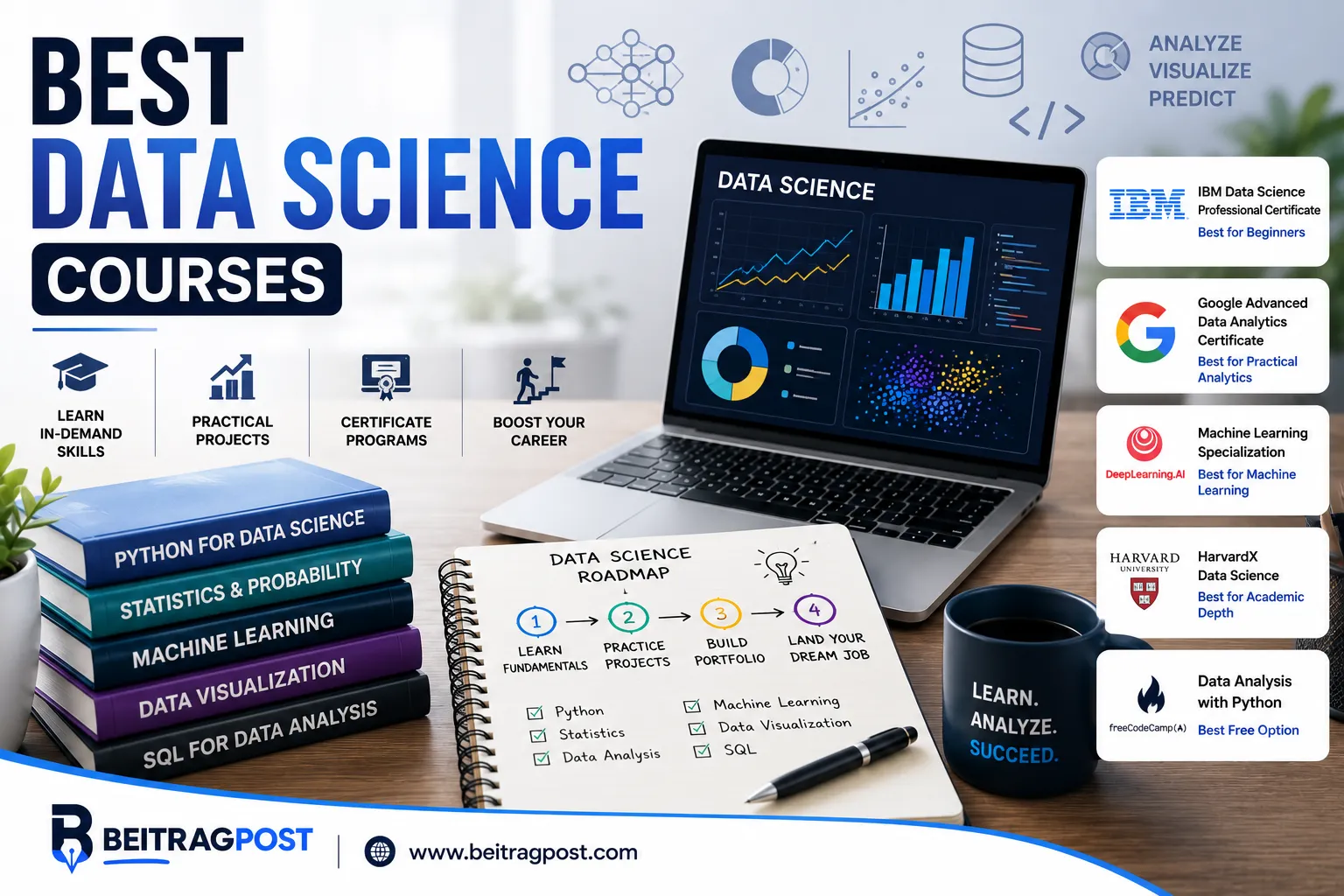
Best overall for beginners: IBM Data Science Professional Certificate
Best for practical analytics: Google Advanced Data Analytics Certificate
Best for machine learning: DeepLearning.AI Machine Learning Specialization
Best for academic depth: HarvardX Data Science
Best free option: freeCodeCamp Data Analysis
Course content, pricing, access, and certificate policies can change, so check the provider’s current details before enrolling.
How We Chose the Best Data Science Courses
A data science course should do more than introduce a collection of tools.
We considered the factors that matter when you’re actually trying to learn data science and apply it to real work.
Curriculum Quality
A strong course should cover the fundamentals before moving into advanced topics.
Important areas include Python, statistics, SQL, data cleaning, visualization, and machine learning.
Hands-On Projects
Projects are one of the best ways to turn theoretical knowledge into practical ability.
A course becomes much more useful when you have opportunities to work with datasets, analyze problems, build models, and explain your findings.
Learning Curve
Some programs assume that you already know programming or statistics.
Others start from the basics.
Matching the course difficulty to your current skill level can prevent unnecessary frustration.
Career Relevance
The strongest programs should help you develop skills that can be demonstrated through projects, a portfolio, or practical assessments.
A certificate alone does not guarantee a job.
Flexibility
Self-paced courses can work well for people balancing work or education.
Structured programs may be better if you need deadlines and a defined learning path.
IBM Data Science Professional Certificate
Best Overall for Beginners
IBM’s Data Science Professional Certificate is a strong starting point for learners who want a broad introduction to the field.
It covers several foundational areas rather than focusing exclusively on one specialized skill.
That makes it suitable for people who are still figuring out which part of data science interests them most.
What You’ll Learn
Depending on the current course structure, topics can include:
- Python
- Data analysis
- Data visualization
- SQL
- Machine learning
- Data science methodology
- Practical projects
The broader curriculum can help beginners understand how different parts of a data science workflow connect.
Best For
- Complete beginners
- Career changers
- Learners who want structured training
- People building a first data science portfolio
Pros
- Broad foundation
- Beginner-friendly progression
- Practical components
- Recognized provider
Cons
- Can take significant time to complete
- Some learners may prefer a more specialized path
- Advanced learners may find the early material too basic
Verdict
IBM’s certificate is one of the strongest starting points if you want a structured introduction to data science without assuming extensive prior knowledge.
Google Advanced Data Analytics Professional Certificate
Best for Practical Analytics Skills
Google’s Advanced Data Analytics Professional Certificate is aimed at learners who want to build stronger analytical and technical skills.
It goes beyond basic data analysis and introduces concepts that can help learners move toward more advanced analytical work.
Best For
- Career-focused learners
- Aspiring data analysts
- Beginners with some foundation
- Learners interested in Python and statistics
What Makes It Useful?
The program emphasizes practical analytical workflows.
That can help learners understand how data is collected, prepared, analyzed, visualized, and interpreted.
Projects and practical exercises can also help turn individual lessons into demonstrable skills.
Pros
- Career-oriented
- Practical learning
- Strong analytical focus
- Useful progression for learners with some foundation
Cons
- Not necessarily the easiest first course for someone completely new to programming
- Advanced learners may want deeper specialization
Verdict
Choose this option if your goal is to develop practical analytics skills while moving toward more advanced data work.
DeepLearning.AI Machine Learning Specialization
Best for Machine Learning Fundamentals
If you already understand basic programming and want to move toward machine learning, DeepLearning.AI’s Machine Learning Specialization is a strong option.
The focus is narrower than a general data science certificate.
That’s an advantage if machine learning is the area you specifically want to develop.
What You’ll Learn
The curriculum covers fundamental machine learning concepts and practical modeling techniques.
Topics can include:
- Supervised learning
- Unsupervised learning
- Model evaluation
- Regression
- Classification
- Clustering
- Machine learning workflows
Best For
- Learners with basic programming knowledge
- Aspiring machine learning professionals
- Data science students
- Developers moving into machine learning
Pros
- Focused curriculum
- Strong machine learning foundation
- Practical orientation
- Suitable progression beyond beginner material
Cons
- Not the best starting point for someone with no programming background
- Less focused on the broader data science workflow
Verdict
Pick this course when machine learning is your main goal rather than learning every area of data science at once.
HarvardX Data Science
Best for Statistics and Academic Depth
HarvardX offers data science education with a stronger academic emphasis.
This can appeal to learners who want to understand the statistical foundations behind data analysis rather than simply learning which buttons to press in a software tool.
Best For
- Learners who enjoy theory
- Students with mathematical interest
- Professionals strengthening statistical knowledge
- Intermediate learners
What Makes It Different?
Statistics plays a major role in good data science.
Understanding probability, uncertainty, sampling, modeling, and inference helps you evaluate whether your conclusions actually make sense.
That foundation can become particularly valuable as you move into more complex analytical work.
Pros
- Strong academic foundation
- Statistical depth
- Well suited to serious learners
- Useful theoretical perspective
Cons
- Can feel more demanding than beginner-focused programs
- Learners seeking only practical tools may prefer a more hands-on course
Verdict
HarvardX is a good choice if you want stronger statistical and theoretical foundations behind your data science skills.
DataCamp Data Scientist Track
Best for Interactive Practice
DataCamp takes a highly interactive approach to technical education.
Instead of relying entirely on long lectures, learners can spend more time writing code and working through guided exercises.
That can be useful when you’re learning programming or data analysis for the first time.
Best For
- Interactive learners
- Beginners learning Python
- Data analysis practice
- People who prefer short lessons
Why Interactive Learning Helps
Data science involves technical skills that are difficult to master through passive watching alone.
Writing code repeatedly helps you become more comfortable with syntax, data manipulation, and problem-solving.
DataCamp’s interactive format can therefore make practice a central part of the learning experience.
Pros
- Hands-on exercises
- Short learning sessions
- Broad technical topics
- Beginner-friendly interface
Cons
- Subscription model
- Learners still need independent projects
- Interactive exercises alone aren’t enough to build a complete portfolio
Verdict
DataCamp is a strong choice if you learn best by doing rather than watching long lectures.
freeCodeCamp Data Analysis
Best Free Option
If your budget is limited, freeCodeCamp is one of the first resources worth exploring.
Its educational content is freely available, making it useful for learners who want to develop technical skills without immediately paying for a large program.
Best For
- Students
- Budget-conscious learners
- Beginners
- Self-directed learners
What Makes It Valuable?
The biggest advantage is accessibility.
You can start learning without making a significant financial commitment.
However, free resources require more self-discipline.
There may not be the same level of structured support, career guidance, or accountability that comes with a paid program.
Pros
- Free
- Accessible
- Practical coding focus
- Useful for self-learning
Cons
- Less structured than some paid programs
- Requires strong self-discipline
- You may need additional resources for advanced topics
Verdict
freeCodeCamp is an excellent starting point if cost is your biggest concern and you’re comfortable learning independently.
MIT OpenCourseWare
Best for Advanced Learners
MIT OpenCourseWare is different from many commercial online courses.
It provides access to educational materials from MIT courses, allowing independent learners to explore rigorous academic content.
This can be particularly useful if you want to deepen your understanding rather than simply follow a career-focused curriculum.
Best For
- Advanced learners
- Students
- Technical professionals
- Self-directed learners
- People interested in mathematical foundations
Pros
- High-quality academic material
- Rigorous content
- Free access to many resources
- Excellent for deeper study
Cons
- Not designed specifically as a beginner career program
- Less guided than structured certificate programs
- Requires more independent study
Verdict
MIT OpenCourseWare is best for learners who already have a foundation and want to study data-related concepts at a deeper academic level.
What Should a Good Data Science Course Teach?
Before enrolling, check the curriculum carefully.
A good data science learning path should gradually develop several connected skills.
Python
Python is widely used for data analysis, automation, visualization, and machine learning.
You don’t need to become a software engineer first.
However, you should understand variables, functions, loops, data structures, libraries, and basic programming logic.
SQL
SQL is essential for working with data stored in databases.
You should eventually become comfortable with:
- SELECT statements
- Filtering
- Sorting
- Aggregations
- JOIN operations
- Grouping
- Basic database concepts
If you’re still developing your programming foundation, our guide to Best Coding Courses Online can help you find additional resources before moving deeper into data science.
Statistics
Statistics helps you understand what your data actually means.
Important topics include:
- Probability
- Distributions
- Mean and variance
- Correlation
- Hypothesis testing
- Regression
- Sampling
- Confidence intervals
Data Visualization
Data scientists need to communicate findings clearly.
Courses should give you experience creating and interpreting visualizations rather than treating charts as an afterthought.
Machine Learning
Machine learning becomes more important as you move beyond descriptive analysis.
A good course should explain the fundamentals before throwing you into complicated algorithms.
Projects
Projects connect everything together.
Look for courses where you analyze realistic datasets and explain the results.
Best Data Science Courses for Beginners
Beginners shouldn’t start by choosing the most advanced machine learning program.
Start with a course that builds the fundamentals in a logical order.
Good Beginner Choices
IBM Data Science Professional Certificate is a strong option for a broad introduction.
DataCamp can work well if you prefer interactive practice.
freeCodeCamp is useful if you want a free starting point and can study independently.
Your first goal should be understanding the workflow:
Question → Data → Cleaning → Analysis → Visualization → Insight
Once that process makes sense, advanced topics become much easier to learn.
Best Data Science Courses for Career Changers
Career changers need more than technical lessons.
You also need a portfolio that demonstrates what you can actually do.
A useful career-focused course should provide:
- Practical projects
- Python experience
- SQL skills
- Statistics
- Data visualization
- Machine learning fundamentals
- Portfolio opportunities
Don’t choose a course solely because it advertises a certificate.
Employers generally care more about whether you can solve problems and explain your work.
Best Free Data Science Courses
Free resources can be enough to build a solid foundation.
A practical free learning path could combine:
- Python fundamentals
- SQL
- Statistics
- Data analysis
- Visualization
- Machine learning
- Portfolio projects
freeCodeCamp and MIT OpenCourseWare are useful starting points, but you don’t need to rely on one provider for everything.
You can combine free resources when a single course doesn’t cover all the skills you need.
If you’re comparing where to study different subjects rather than looking only for data science programs, our guide to Best Online Learning Platforms can help you compare broader learning options.
Are Data Science Certificates Worth It?
A certificate can demonstrate that you completed structured training.
However, it shouldn’t be treated as a substitute for practical ability.
Imagine two candidates.
One has five certificates but cannot explain a project.
The other has one certificate and several well-documented projects showing how they cleaned data, analyzed it, built a model, and communicated the results.
The second candidate may have a stronger practical story.
Use certificates to support your learning.
Don’t use them as your entire portfolio.
How to Choose the Right Data Science Course
Before enrolling, answer five questions.
What Is Your Current Skill Level?
Complete beginners need a different course from experienced programmers.
Don’t start with advanced material simply because it sounds impressive.
What Is Your Career Goal?
Do you want to become a data analyst, data scientist, machine learning engineer, or simply improve your analytical skills?
Your destination should influence your course selection.
How Much Time Can You Study?
A self-paced course may be better if your schedule changes frequently.
A structured program may work better if you need accountability.
Do You Need a Certificate?
If certification matters for your particular goal, check what the course actually provides.
Don’t assume every completion badge has the same professional value.
Does the Course Include Projects?
This should be one of your highest priorities.
Projects help you transform lessons into evidence of practical skill.
Common Mistakes When Choosing a Data Science Course
Choosing Based Only on Price
Cheap isn’t always better.
Expensive isn’t automatically better either.
Look at curriculum, projects, teaching quality, and your actual learning needs.
Starting With Machine Learning Too Early
Machine learning becomes easier when you already understand programming, statistics, and data analysis.
Build the foundation first.
Collecting Certificates Instead of Skills
Completing courses can feel productive.
But watching lessons isn’t the same as being able to solve unfamiliar problems.
Spend time building things.
Ignoring SQL
Python receives a lot of attention in data science education, but SQL remains an important practical skill.
Don’t leave it until the end.
Avoiding Projects
Projects are where concepts become practical.
Even simple projects can teach you more than another hour of passive video watching.
How Long Does It Take to Learn Data Science?
There is no universal timeline.
A beginner studying consistently may build a foundation within several months, while becoming genuinely proficient can take much longer.
Your progress depends on:
- Previous programming experience
- Mathematics background
- Study time
- Course quality
- Practice
- Project work
- Consistency
Don’t focus only on completing lessons.
Focus on what you can actually do after completing them.
Frequently Asked Questions
What is the best data science course for beginners?
The IBM Data Science Professional Certificate is a strong broad starting point. DataCamp is another useful choice for learners who prefer interactive practice, while freeCodeCamp works well for self-directed learners on a budget.
Can I learn data science for free?
Yes. You can build a foundation using free resources such as freeCodeCamp and MIT OpenCourseWare, combined with other freely available tutorials and documentation.
Is a data science certificate enough to get a job?
Usually not. A certificate can support your application, but practical skills, projects, problem-solving ability, and communication are also important.
Should I learn Python before data science?
Learning basic Python first can make the transition into data science much easier. You don’t need advanced programming skills before starting, but you should understand the fundamentals.
Is SQL important for data science?
Yes. SQL is widely used to retrieve and manipulate data stored in databases, making it an important skill for many data-related roles.
Can I learn data science without a mathematics degree?
Yes. You don’t need a mathematics degree to start. However, you’ll eventually need to understand important statistical and mathematical concepts used in data analysis and machine learning.
Which is better: a certificate or a bootcamp?
It depends on your needs. A certificate can provide flexible structured learning, while a bootcamp may provide a more intensive schedule and stronger accountability. Compare the curriculum, projects, support, and total cost rather than choosing based on the format alone.
Final Verdict
The best data science courses depend on where you’re starting and where you want to go.
For beginners who want a broad foundation, the IBM Data Science Professional Certificate is a strong choice. DataCamp works well for learners who prefer interactive practice, while freeCodeCamp provides a valuable free starting point for self-directed students.
If you’re moving toward machine learning, the DeepLearning.AI Machine Learning Specialization provides a more focused path. For learners who want deeper statistical and academic foundations, HarvardX and MIT OpenCourseWare offer valuable material.
Whatever course you choose, don’t make the certificate your final goal.
Learn Python. Build SQL skills. Understand statistics. Practice data analysis. Create projects. Then learn to explain what your analysis means.
That’s the combination that turns an online course into a useful data science skill set.