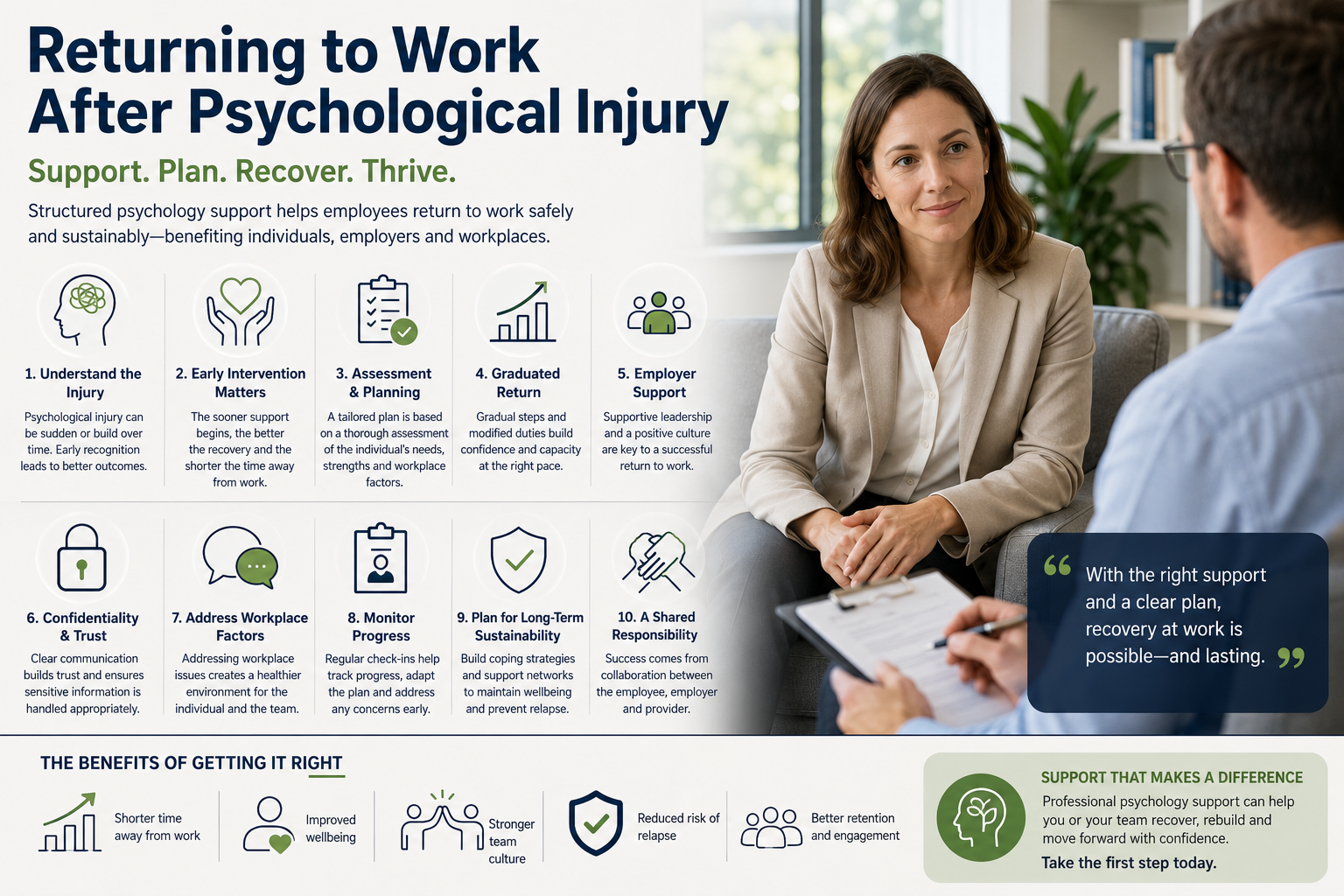
How Psychology Support Services Help Employees Return to Work
Returning to work after a period of psychological injury or significant stress is rarely straightforward, and structured psychology support can make a genuine difference to how that transition unfolds.
Understanding psychological injury at work
Psychological injury can develop from a single traumatic incident or build gradually from prolonged workplace stress, and both forms deserve the same level of genuine, structured support.
Understanding this distinction matters because the pathway to support, and the urgency with which it is needed, can differ meaningfully between a sudden incident and a slow, cumulative build-up.
Recognising early warning signs, such as withdrawal, reduced concentration, or increased absenteeism, allows employers and employees to seek support before a situation escalates significantly.
Training frontline managers to notice these subtler signs, rather than waiting for a crisis point, makes a genuine and measurable difference to how early support can actually begin.
Why early intervention matters
Early intervention consistently leads to better outcomes, both for the individual and for the business, reducing the length of time away from work and the overall cost of a claim.
This benefit compounds over time, as a quicker, well-supported recovery reduces the likelihood of a prolonged absence turning into a considerably more complex, entrenched situation.
Accessing specialist workplace psychology services as soon as concerns arise gives an employee the best possible chance of a smooth, sustainable return to their role.
Delaying support, often out of a hope that things will simply improve on their own, tends to allow a difficult situation to become considerably more entrenched over time.
The longer a person remains away from structured routine and social contact through work, the more difficult a return can become both practically and psychologically.
The assessment and planning process
A proper psychological assessment identifies the specific factors affecting an employee, forming the basis of a genuinely tailored return-to-work plan rather than a generic, one-size-fits-all approach.
This individualised approach recognises that no two employees experience psychological injury identically, even when the underlying triggering event or circumstances appear broadly similar on the surface.
This plan typically outlines gradual steps, realistic timeframes, and any workplace adjustments needed to support a sustainable, rather than rushed, return to normal duties.
Involving the employee directly in shaping this plan, rather than presenting it as a fixed decision, tends to improve both engagement and the eventual outcome.
Building a graduated return-to-work plan
A graduated return, starting with reduced hours or modified duties, allows an employee to rebuild confidence and capacity without the pressure of resuming a full workload immediately.
Regularly reviewing and adjusting this plan as capacity improves helps ensure the pace of return genuinely matches the employee’s actual recovery, rather than an arbitrary timeline.
A plan that feels flexible rather than rigid also reduces pressure on the employee, who may otherwise worry that any setback reflects personal failure.
The employer’s role in a successful return
Employers play a genuinely significant role in a successful return to work, and a supportive, well-informed manager can make an enormous difference to how an employee experiences the process.
A manager who checks in regularly, without being intrusive, helps an employee feel genuinely supported rather than simply monitored during what can be a genuinely vulnerable period.
Training managers to recognise signs of psychological distress and respond appropriately equips workplaces to support employees earlier and considerably more effectively.
A workplace culture that genuinely normalises seeking support, rather than treating it as unusual, makes it considerably easier for employees to come forward early.
Confidentiality and trust in the process
Confidentiality is central to effective psychology support, and employees need genuine confidence that sensitive information will be handled appropriately before they feel comfortable engaging fully with the process.
Clear communication about exactly what information is shared with an employer, and what remains strictly confidential, helps build the trust this kind of support genuinely depends on completely.
Just as a business benefits from a proper free blog audit before making changes, a psychology provider benefits from a thorough, confidential assessment before recommending a specific course of support.
Addressing workplace factors directly
Sometimes a return-to-work plan needs to address specific workplace factors directly, such as team dynamics or role demands, rather than focusing solely on individual coping strategies.
A psychologist experienced in workplace settings can help facilitate these conversations constructively, balancing an employee’s needs with genuine operational realities of the business.
These structured conversations often resolve tensions that might otherwise fester unaddressed, benefiting the broader team as well as the individual employee involved.
Measuring progress along the way
Regular check-ins between the employee, employer, and psychology provider help track progress and catch any emerging concerns before they derail an otherwise positive return.
These check-ins also give an employee a genuine, structured opportunity to raise concerns early, rather than feeling they need to struggle through in silence.
Keeping these conversations brief and genuinely supportive, rather than overly formal, tends to encourage more open and honest communication from the employee.
Supporting long-term sustainability
The goal extends beyond simply getting an employee back to work, aiming instead for a genuinely sustainable return that reduces the risk of a future relapse or setback.
Building ongoing coping strategies and support networks during this period helps protect an employee’s wellbeing well beyond the immediate return-to-work timeframe.
Some employees benefit from continued periodic check-ins with a psychologist well after officially returning to full duties, as a preventative rather than reactive measure.
A shared responsibility for a good outcome
A successful return to work after psychological injury depends on genuine collaboration between the employee, employer, and psychology provider, each playing their part in the process.
Investing properly in this kind of structured support ultimately benefits everyone involved, from the individual employee through to the wider workplace culture over time.
Businesses that prioritise this kind of support tend to see genuine, measurable benefits in staff retention, morale, and overall workplace culture that extend well beyond any single case.