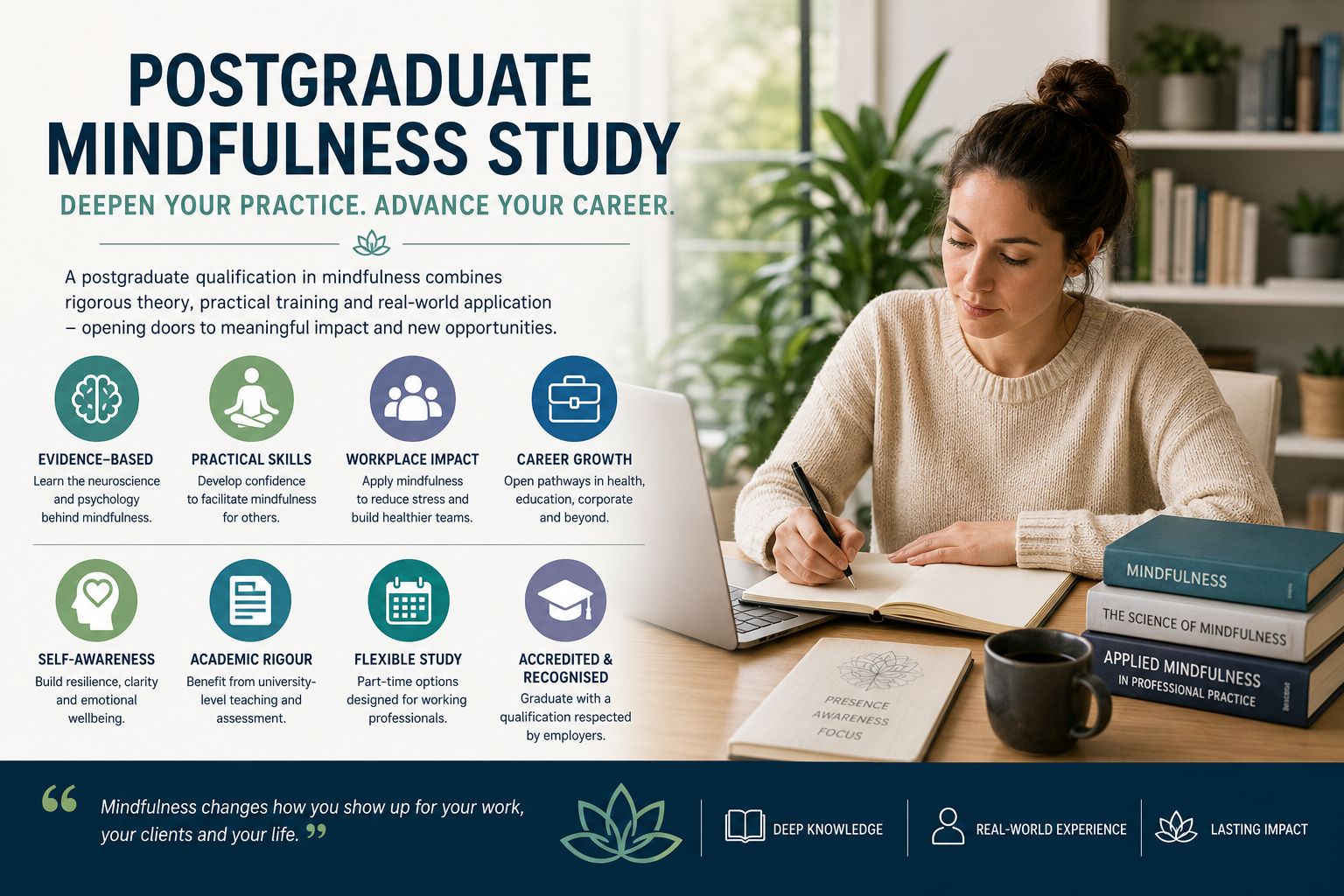
How a Postgraduate Mindfulness Qualification Builds Career Skills
Mindfulness has moved well beyond wellness circles and into mainstream professional development, with more people now pursuing formal postgraduate study in the field for genuine career reasons.
Why mindfulness study appeals to professionals
Professionals from healthcare, education, and corporate backgrounds are increasingly drawn to structured mindfulness study as a way to deepen skills they already use informally in their daily work.
Unlike a casual weekend workshop, a postgraduate qualification offers rigorous grounding in both the theory and the practical application of mindfulness across different professional settings.
This rigour matters to employers as well, since a recognised qualification signals a genuinely serious level of training rather than a passing interest picked up from a single short course.
What a typical course actually covers
Enrolling in a university mindfulness course typically involves a mix of contemplative practice, psychological theory, and supervised practical application across a structured semester timetable.
Students usually study the neuroscience underpinning mindfulness alongside its practical delivery, giving graduates a genuinely well-rounded understanding rather than technique alone without the theory behind it.
Assessment often combines written coursework with supervised practical sessions, meaning students are tested on both their theoretical understanding and their genuine ability to actually deliver sessions confidently and competently.
Building genuine self-awareness
One of the most valuable outcomes of postgraduate mindfulness study is the depth of self-awareness it builds, which flows directly into how graduates manage stress and workplace relationships.
This self-awareness often proves just as valuable as any specific technique learned, since it changes how graduates respond to pressure in ways that colleagues and clients genuinely notice over time.
Many students describe this shift as one of the more unexpected outcomes of the course, since they enrolled expecting to learn a skill and instead found their whole outlook shifting gradually.
Developing practical facilitation skills
Beyond personal practice, most courses include structured training in how to facilitate mindfulness sessions for others, a skill increasingly valued across healthcare, education, and corporate wellbeing programs.
Learning to hold space for a group, respond to unexpected reactions during practice, and adapt sessions for different audiences takes considerably more skill than most people initially expect.
Supervised placements during the course give students a genuinely safe environment to practise these facilitation skills before being expected to lead sessions entirely on their own.
Applying mindfulness in the workplace
Graduates frequently apply what they learn directly within their existing workplace, introducing structured mindfulness practices to teams dealing with high stress or significant organisational change.
Employers increasingly value staff who bring this kind of applied expertise, particularly in industries where burnout and high staff turnover are already recognised as ongoing challenges.
Some organisations now actively support staff pursuing this kind of qualification, recognising the flow-on benefits for team culture and overall workplace wellbeing, even contributing toward course fees in some cases.
Career pathways after graduation
Graduates go on to a wide range of roles, from dedicated wellbeing coordinators within larger organisations to independent practitioners running their own mindfulness-based programs and workshops.
Some also integrate their qualification into an existing career, such as counselling, teaching, or human resources, adding a genuinely distinct and valuable skill set to their existing expertise.
Others use the qualification as a genuine stepping stone into an entirely new direction, particularly those looking to move away from a career that no longer feels sustainable or fulfilling.
The research and evidence base
A strong postgraduate program grounds its teaching in current research, helping students understand not just how mindfulness techniques work, but the evidence supporting their effectiveness in different contexts.
This evidence-based grounding also gives graduates the confidence and credibility to speak about mindfulness in genuinely rigorous, professional terms rather than relying on anecdote or personal opinion alone.
Just as businesses appearing among top New South Wales websites benefit from a credible, well-established reputation, graduates benefit from a qualification built on a genuinely credible academic and research foundation.
Balancing study with existing commitments
Many postgraduate mindfulness programs are designed with working professionals in mind, offering part-time study options and flexible scheduling around existing employment commitments.
This flexibility makes it genuinely realistic for someone already established in a career to complete a qualification without needing to step away from paid work for an extended period.
Studying alongside a cohort of similarly experienced professionals also brings genuine value, since peer discussion often surfaces practical insights that reading alone simply cannot provide.
Choosing the right course and institution
Comparing course structure, teaching staff, and the practical placement opportunities on offer helps prospective students choose a program that genuinely matches their specific career goals.
Speaking directly with current students or recent graduates, where possible, often reveals far more about the day-to-day experience of a course than a prospectus alone ever could.
It is also worth checking whether a course holds proper accreditation, since this can matter considerably for graduates wanting to practise professionally after finishing their studies.
The personal benefits alongside professional ones
Beyond career advancement, many graduates describe genuinely meaningful personal benefits from their studies, including improved resilience, better relationships, and a stronger overall sense of wellbeing.
This dual benefit, personal and professional, is part of why interest in postgraduate mindfulness study has continued to grow steadily across a wide range of industries.
Word of mouth from satisfied graduates has also played a genuine role in this growth, as personal recommendation often carries more weight than any marketing material could.
Is postgraduate study the right step
For those already practising mindfulness informally, formal postgraduate study offers a genuine way to deepen understanding, build credibility, and open up new professional opportunities.
Considering personal goals, available time, and career direction carefully before enrolling helps ensure the investment of time and money leads to a genuinely worthwhile outcome.
For many graduates looking back, the qualification ultimately delivers considerably more value than they initially expected, both professionally and personally, well beyond what they first anticipated when they enrolled.