How to Get Better at Video Games: Practical Tips
If you want to know how to get better at video games, the answer isn’t simply to play more. Improvement comes from playing with a purpose, identifying your weaknesses, practicing specific skills, and learning from mistakes.
You don’t need to spend every free hour gaming to become better. In many cases, a focused practice session can teach you more than several hours of unfocused play.
Whether you play competitive shooters, sports games, strategy games, fighting games, or multiplayer titles, the same basic improvement principles apply. The goal is to turn ordinary gaming sessions into deliberate practice without making gaming feel like a second job.
The Fastest Way to Get Better at Video Games
Before changing your settings, buying new equipment, or watching hours of professional gameplay, start with your fundamentals.
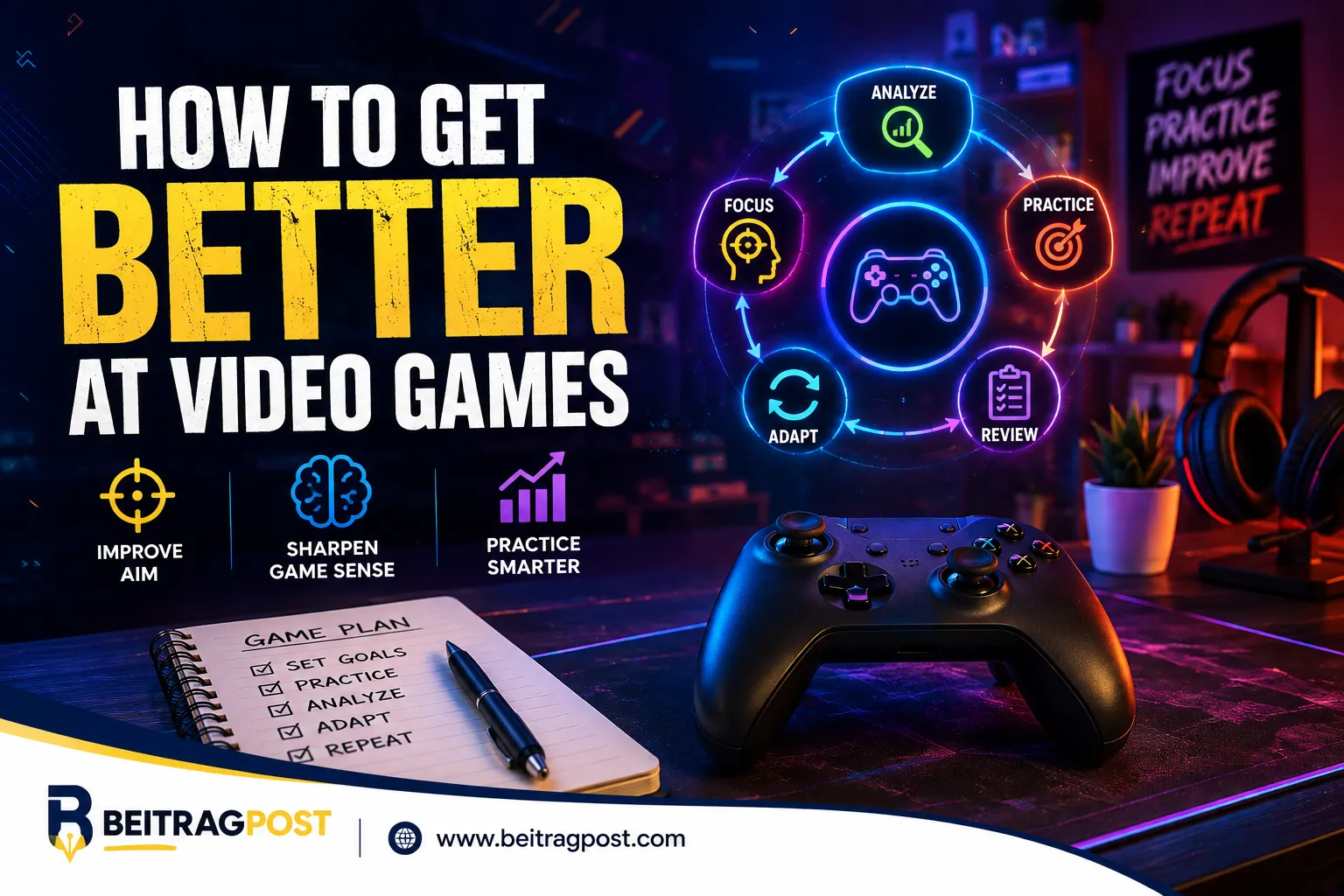
A simple improvement cycle looks like this:
- Identify one weakness.
- Practice that specific skill.
- Play real matches using it.
- Review what went wrong.
- Adjust your approach.
- Repeat the process.
This approach is more effective than trying to improve everything at once.
If your aim is inconsistent, focus on aim. And If you constantly make poor decisions, work on game sense. If you lose because you don’t understand the map, study positioning and routes.
Focus creates measurable improvement.
1. Identify What Is Holding You Back
The first step is figuring out why you’re losing.
Many players assume they need faster reactions when their real problem is positioning. Others blame their aim when they’re taking fights they shouldn’t take.
After a difficult match, ask yourself:
- Why did I lose that fight?
- Was my aim inaccurate?
- Did I make the wrong decision?
- Did I misunderstand my opponent?
- Was I in a bad position?
- Did I rush when I should have waited?
- Did I lack information?
- Did I make the same mistake repeatedly?
Try to identify patterns instead of focusing on individual failures.
If you repeatedly die in similar situations, you’ve found something worth practicing.
Focus on Your Biggest Weakness
Don’t try to fix five problems simultaneously.
Choose the weakness that has the biggest impact on your results.
For example, a shooter player might discover that their aim is acceptable but their positioning causes most deaths. Spending another ten hours practicing aim won’t solve the main problem.
Fix the biggest weakness first.
2. Learn the Fundamentals of Your Game
Every game has fundamentals.
In a shooter, these might include aiming, movement, positioning, map awareness, and resource management.
And In a strategy game, fundamentals could involve economy, unit management, timing, scouting, and decision-making.
In a fighting game, spacing, defense, combos, and matchup knowledge can matter more.
Before chasing advanced techniques, make sure you understand the basics.
Learn What Your Game Rewards
Different games reward different behaviors.
Some favor aggressive play. Others punish unnecessary fights.
Some reward mechanical precision. Others place more emphasis on strategy and decision-making.
Understanding the game’s core rules helps you make better choices instead of copying techniques without knowing why they work.
Study the Objective
A surprisingly common mistake is confusing kills with winning.
In many multiplayer games, eliminating opponents helps, but it isn’t always the primary objective.
You may improve your statistics while still losing because you’re ignoring objectives, positioning, resources, or team coordination.
Always ask:
What actually wins the game?
Then make your decisions around that answer.
3. Practice One Skill at a Time
One of the biggest mistakes players make is practicing without a specific goal.
They play match after match and expect improvement to happen automatically.
Instead, give each session a purpose.
For example:
Aim session: Focus on accuracy and controlled movement.
Movement session: Practice positioning, dodging, or movement mechanics.
Game-sense session: Focus on predicting opponents and gathering information.
Decision-making session: Pay attention to when you engage, retreat, or change strategy.
You don’t need to practice every skill during every session.
Use Short, Focused Sessions
You can often get more value from 30 minutes of focused practice than several hours of distracted gaming.
Start with a specific objective.
For example:
“Today I’m going to focus on staying in better positions.”
Then evaluate whether you improved.
This gives your brain something specific to notice during gameplay.
4. Stop Playing on Autopilot
Playing for hours doesn’t guarantee improvement.
If you’re repeating the same habits without thinking about them, you’re mostly reinforcing your current level.
Autopilot often looks like:
- Repeating the same route
- Taking the same unnecessary fights
- Using the same strategy
- Ignoring mistakes
- Blaming teammates
- Continuing despite frustration
Instead, stay mentally engaged.
Before making an important decision, briefly consider:
What information do I have?
And What is my opponent likely to do?
What is my safest or strongest option?
You don’t need to overthink every move.
The goal is simply to become more aware of your decisions.
5. Review Your Mistakes
One of the fastest ways to improve is learning from what already happened.
After a bad match, don’t just queue again immediately.
Take a few minutes to think about your biggest mistakes.
If your game supports replay recording, reviewing your gameplay can be even more useful.
Look for moments where:
- You were out of position
- You missed important information
- You reacted too late
- You made an unnecessary commitment
- You misunderstood the situation
- You repeated a previous mistake
Ask Better Questions
Instead of saying:
“I’m terrible at this.”
Ask:
“What could I have done differently?”
That question turns frustration into useful information.
You don’t need to analyze every second of a match. Find two or three important moments and understand what caused them.
6. Improve Your Aim and Mechanical Skills
Mechanical ability matters in many competitive games.
Aim, movement, timing, combinations, and precision can determine whether a good decision actually succeeds.
However, mechanical practice should be specific.
If you play a shooter, for example, don’t simply spend hours shooting targets without understanding what you’re practicing.
Work on skills such as:
- Tracking moving targets
- Flicking between targets
- Crosshair placement
- Recoil control
- Movement while aiming
- Target selection
- Shooting discipline
Prioritize Accuracy Over Speed
Many players try to make their movements faster before becoming consistent.
That can create sloppy habits.
Start by performing the movement correctly.
Then gradually increase speed while maintaining control.
Consistency usually matters more than performing an impressive technique occasionally.
7. Improve Your Game Sense
Game sense is the ability to understand what’s happening and anticipate what may happen next.
It develops through experience, observation, and deliberate thinking.
You can improve it by paying attention to:
- Enemy positions
- Teammate locations
- Objectives
- Available resources
- Common routes
- Timing
- Previous enemy behavior
Over time, you’ll start recognizing patterns.
For example, if an opponent repeatedly takes the same route, you can anticipate it rather than reacting after they appear.
That is game sense.
Learn From Better Players
Watching skilled players can accelerate your understanding, but don’t watch passively.
Instead of thinking:
“That player is really good.”
Ask:
- Why did they move there?
- Why did they avoid that fight?
- What information did they have?
- Why did they use that ability?
- What were they expecting the opponent to do?
The goal isn’t to copy their movements blindly.
It’s to understand their decisions.
8. Learn Maps, Mechanics, and Common Patterns
Knowledge can compensate for mechanical weaknesses.
Knowing where opponents usually appear, where objectives are located, and which routes are commonly used allows you to make better decisions before a fight even starts.
Depending on the game, study:
- Maps
- Spawn locations
- Objective positions
- Resource locations
- Common strategies
- Character abilities
- Weapon strengths
- Cooldowns
- Popular routes
You don’t need to memorize everything immediately.
Start with the information that affects your matches most often.
Build Mental Shortcuts
Experienced players often recognize situations quickly because they’ve seen them many times.
Instead of processing every detail from scratch, they recognize familiar patterns.
The more you play thoughtfully, the more these patterns become automatic.
9. Watch Better Players the Right Way
Watching professional or highly skilled players can help, but only if you pay attention to decisions.
Don’t spend an hour watching someone play while barely thinking about what they’re doing.
Choose a specific skill to study.
For example:
Improving positioning: Watch where they stand before fights.
And Improving decision-making: Watch when they choose to engage or retreat.
Improving mechanics: Study their movement and execution.
Improving game sense: Pay attention to how they gather information.
You can also pause gameplay before a major decision and predict what you would do.
Then compare your choice with theirs.
That turns watching into active learning.
10. Improve Your Settings and Controls
Your equipment and settings can influence performance, but they won’t replace skill.
Before changing everything, find settings that feel comfortable and keep them consistent long enough to adapt.
Depending on the game, consider:
- Mouse or controller sensitivity
- Key bindings
- Field of view
- Graphics settings
- Audio settings
- Display settings
- Controller dead zones
Don’t Constantly Change Sensitivity
One common mistake is changing settings after every bad match.
You miss a few shots, change sensitivity.
Lose another game, change it again.
That makes it difficult to develop consistent muscle memory.
Choose a comfortable configuration and give yourself time to adapt.
11. Use Better Gaming Equipment When It Actually Helps
Better equipment can improve comfort and consistency, but expensive hardware isn’t a shortcut to becoming a better player.
A reliable mouse, comfortable controller, responsive display, and clear audio can remove unnecessary limitations.
Audio can be particularly important in competitive games where directional information matters.
If you’re considering an upgrade, our guide to Best Gaming Headsets can help you compare options based on comfort, sound quality, microphone performance, and gaming needs.
The important point is to upgrade because your current equipment is limiting you—not because you believe new hardware will automatically make you better.
12. Communicate Better With Teammates
In team-based games, individual skill is only part of the equation.
Good communication can turn a mechanically average team into a difficult opponent.
Keep communication:
- Short
- Clear
- Relevant
- Calm
Instead of shouting when something goes wrong, provide useful information.
For example:
“Two opponents on the left.”
is more useful than:
“Why is nobody helping?”
Good communication gives teammates information they can act on.
Don’t Blame Teammates
Blaming other players may feel satisfying, but it doesn’t improve your own performance.
Even when a teammate makes a mistake, ask what you could have done differently.
Could you have communicated earlier?
And Could you have changed position?
Could you have played more defensively?
You can’t control teammates, but you can control your own decisions.
13. Learn to Manage Frustration
Mental performance matters.
When you’re frustrated, your decision-making often becomes worse.
You may:
- Rush fights
- Take unnecessary risks
- Stop communicating
- Blame others
- Ignore mistakes
- Keep playing despite losing focus
Recognize the signs early.
If you’re becoming angry after several losses, take a break.
A short reset can be more productive than continuing to play while frustrated.
14. Take Breaks to Avoid Burnout
More gaming isn’t always better practice.
Your concentration declines when you’re mentally exhausted.
Long sessions can also make repeated mistakes feel normal because you stop noticing them.
Try using reasonable breaks between focused sessions.
Stand up, get some water, rest your eyes, and return when you’re ready to concentrate again.
The goal isn’t to maximize hours played.
It’s to maximize the quality of those hours.
15. Build a Simple Practice Routine
You don’t need an elaborate training schedule.
A basic routine can be enough.
Before Playing
Spend a few minutes warming up or reviewing the skill you’re working on.
During Matches
Focus on one improvement goal.
After the Match
Identify one mistake and one thing you did well.
At the End of the Session
Ask:
- What improved?
- What still feels weak?
- What should I practice next?
This creates a continuous feedback loop.
Example Practice Routine
If you’re trying to improve at a competitive game, your session could look like this:
10 minutes: Warm-up
20 minutes: Practice one mechanical skill
30–60 minutes: Play focused matches
5–10 minutes: Review mistakes
You can adjust the timing based on your schedule.
Consistency matters more than following an exact routine.
16. Play Different Games for Different Skills
Playing different genres can expose you to different types of decision-making.
Strategy games can improve planning.
Puzzle games can encourage pattern recognition.
Fighting games can improve timing and reactions.
Shooters can develop precision and spatial awareness.
That doesn’t mean you need to constantly switch games.
If your goal is competitive improvement, staying with one game is usually better for building deep knowledge.
However, playing other genres occasionally can develop transferable skills and keep gaming enjoyable.
If you’re looking for something new to practice, our guide to Best Games to Play in 2026 can help you explore different genres and gameplay styles.
17. Don’t Chase Every New Strategy
Competitive games often have constantly changing strategies.
A new character becomes popular.
A new weapon becomes powerful.
A different strategy starts appearing everywhere.
Learning the current game environment can be useful, but constantly changing your entire playstyle can prevent you from developing fundamentals.
Build a strong foundation first.
Then adapt when the game actually requires it.
Fundamentals such as positioning, awareness, timing, communication, and decision-making remain valuable even when specific strategies change.
18. Track Your Progress
Improvement is easier to recognize when you measure something.
You don’t need complicated statistics.
Track one or two meaningful indicators.
Depending on the game, that might include:
- Win rate
- Accuracy
- Average score
- Deaths per match
- Objective participation
- Successful decisions
- Ranking progress
Don’t become obsessed with the number.
Use it as feedback.
If your statistics improve while your gameplay feels more controlled, you’re probably moving in the right direction.
How Long Does It Take to Get Better at Video Games?
There isn’t a universal timeline.
Some players notice improvements within a few focused sessions. Others need weeks or months to develop stronger mechanics and game knowledge.
Your rate of improvement depends on:
- Your current skill level
- The game you play
- How often you practice
- The quality of your practice
- How quickly you identify mistakes
- How well you apply feedback
The important factor is not simply how many hours you play.
It’s what happens during those hours.
An hour of deliberate practice can be more valuable than several hours of repetitive gameplay.
Common Mistakes That Slow Your Progress
Even motivated players can accidentally make improvement harder.
Playing Without a Goal
If every session is simply another collection of matches, you may not know what you’re trying to improve.
Set one clear objective.
Changing Settings Constantly
Frequent sensitivity and control changes make consistency harder.
Give your setup time before deciding it isn’t working.
Copying Better Players
Copying a professional’s settings or strategy doesn’t automatically make you better.
Understand why their approach works first.
Focusing Only on Wins
Wins are useful, but they’re not the only measure of progress.
A loss where you corrected a major weakness can be more valuable than an easy win.
Ignoring Your Own Mistakes
It’s easy to blame teammates, matchmaking, lag, or bad luck.
Sometimes those factors genuinely matter.
But your improvement comes from identifying what you can control.
Practicing Too Many Skills
Trying to improve everything at once makes progress difficult to measure.
Choose one weakness and work on it consistently.
A Simple Formula for Getting Better at Video Games
If you want to remember only one thing from this guide, use this cycle:
Play → Identify → Practice → Review → Adjust → Repeat
Play enough to encounter real situations.
Identify your biggest weakness.
Practice that specific skill.
Review what happened.
Adjust your approach.
Then repeat.
That’s how casual gaming gradually becomes deliberate improvement.
Frequently Asked Questions
How can I get better at video games quickly?
Focus on one weakness instead of trying to improve everything simultaneously. Practice that skill deliberately, review your mistakes, and apply what you learn during real matches.
Does playing more make you better at games?
Not automatically. Playing more can build experience, but repetitive play can reinforce bad habits. Focused practice and reviewing mistakes are usually more effective.
How can I improve my aim in video games?
Practice accuracy, crosshair placement, tracking, movement, and recoil control. Start with consistency before trying to increase speed.
How do I improve my game sense?
Study maps, observe opponents, review your gameplay, and pay attention to why skilled players make specific decisions. Game sense develops through repeated exposure and thoughtful play.
Can better gaming equipment make me better?
Good equipment can remove technical limitations and improve comfort, but it cannot replace practice. Upgrade when your current equipment is genuinely holding you back.
Should I watch professional gamers to improve?
Yes, if you watch actively. Study their positioning, decision-making, timing, and information gathering instead of simply watching for entertainment.
How many hours should I practice gaming?
There is no universal number. A shorter, focused session can be more useful than a long session where you’re tired or playing without a goal.
Final Verdict
Learning how to get better at video games doesn’t require endless grinding.
The most effective approach is deliberate practice.
Find the skill that’s holding you back, practice it with a clear goal, review your mistakes, and apply what you’ve learned during real games.
Don’t ignore fundamentals while chasing advanced techniques. Good positioning, awareness, decision-making, communication, and consistency often matter more than simply having faster reactions.
Your equipment can support your performance, but it shouldn’t become an excuse for poor fundamentals. Likewise, watching skilled players can accelerate learning when you focus on the decisions behind their actions.
Most importantly, give improvement time.
You won’t fix every weakness in one session. However, if every session teaches you something and you consistently work on the areas that matter most, your gameplay will become more controlled, confident, and effective over time.