How to Make Money Online 15 Legitimate Ways That Actually Work
The fastest legitimate ways to make money online are freelancing, virtual assistance, and online tutoring all of which produce income within weeks for people with existing skills. On the other hand, methods like blogging, YouTube, and affiliate marketing take longer but build recurring income that compounds over time. The right choice depends on how quickly you need money, what skills you currently have, and how much time you can realistically invest each week.
This guide covers 15 proven methods with step-by-step guidance inside each one, realistic income figures backed by real data, pro tips, common mistakes to avoid, real-world examples, a decision tree to help you choose, and a 30-day action plan to start immediately.
The Online Income Opportunity — What the Data Shows
The opportunity is real and measurable. The global freelance market reached $1.5 trillion in 2024 according to Staffing Industry Analysts. The creator economy generated $250 billion in the same year according to Goldman Sachs research. Upwork’s 2025 Skills Index reports that 64 million Americans performed freelance work in the past year roughly 38 percent of the entire US workforce.
Remote work job postings on LinkedIn grew 135 percent between 2020 and 2025. Digital product sales on platforms like Gumroad and Etsy increased 89 percent between 2022 and 2024. These are not vanity statistics they represent real businesses paying real people for real skills delivered online.
What these numbers mean practically is that the demand for online skills, content, and services has never been higher. The question is not whether online income is possible. It is which method fits your specific situation right now.
All 15 Methods
| Method | Time to First Income | Monthly Income Range | Difficulty | Passive? | Best For |
|---|---|---|---|---|---|
| Freelancing | 2 to 8 weeks | $500 — $8,000+ | Medium | No | Skilled professionals |
| Virtual Assistant | 1 to 4 weeks | $800 — $3,500 | Low | No | Organized beginners |
| Online Tutoring | 1 to 3 weeks | $600 — $4,000 | Medium | No | Subject experts |
| Social Media Management | 2 to 6 weeks | $1,500 — $6,000 | Low-Medium | No | Creative people |
| Online Consulting | 2 to 8 weeks | $3,000 — $15,000+ | High | No | Experienced professionals |
| SEO Services | 4 to 10 weeks | $1,500 — $8,000 | Medium-High | No | Marketing enthusiasts |
| AI-Assisted Services | 1 to 4 weeks | $1,000 — $6,000 | Low-Medium | No | Tech-savvy beginners |
| Selling Digital Products | 4 to 12 weeks | $500 — $10,000+ | Medium | Yes | Creators and experts |
| Affiliate Marketing | 3 to 12 months | $500 — $20,000+ | Medium | Yes | Content creators |
| Blogging | 6 to 18 months | $1,000 — $15,000+ | Medium | Yes | Writers and researchers |
| YouTube | 6 to 18 months | $500 — $30,000+ | Medium | Partial | On-camera personalities |
| Print on Demand | 4 to 10 weeks | $300 — $3,000 | Low | Yes | Designers and artists |
| Dropshipping | 6 to 16 weeks | $500 — $10,000+ | Medium | No | Business-minded people |
| Remote Customer Support | 1 to 3 weeks | $1,500 — $3,500 | Low | No | Anyone starting out |
| Stock Photography | 3 to 12 months | $200 — $2,000 | Medium | Yes | Photographers |
Which Method Is Right For You?
You need money within 7 days:
Remote customer support or virtual assistance. Both have companies actively hiring with minimal onboarding. Apply to three to five positions today on Remote.co and We Work Remotely. Do not spend time researching other methods apply first, research later.
You need money within 30 days:
Freelancing or online tutoring. Both produce a first payment within two to four weeks for someone with a marketable skill who actively pursues clients rather than waiting for them to find you.
You need money within 3 months:
Social media management, AI-assisted services, or selling digital products. These require slightly more setup but reward focused effort within a realistic timeframe without requiring a large existing audience.
You are building for 6 to 12 months from now:
Affiliate marketing, blogging, or YouTube. These require patience and consistency before income becomes meaningful but produce genuinely passive income once established that no service-based method can match.
You have professional expertise and want premium income:
Consulting. The income ceiling is higher than anything else on this list, and the path to first income is faster than most people expect when approached with direct client outreach rather than waiting to be discovered.
Who Should Choose Which Method
| If you are… | Best Method | Why |
|---|---|---|
| A student | Online tutoring | Use existing academic knowledge immediately |
| A designer or creative | Freelancing or Print on Demand | Monetize existing creative skills |
| A writer | Freelancing or Blogging | Writing skills transfer directly |
| A stay-at-home parent | Virtual Assistant | Flexible hours, low barrier to entry |
| Working a full-time job | Affiliate Marketing or Digital Products | Build passively alongside existing work |
| Need money today | Remote Customer Support | Fastest hiring with lowest requirements |
| An experienced professional | Consulting | Highest income ceiling, fastest premium income |
| Tech-savvy beginner | AI-Assisted Services | Growing demand, low competition currently |
Before You Start — The One Thing That Matters More Than Method Choice
Every method on this list has produced real income for real people. Every method has also produced zero income for people who tried it half-heartedly or switched to something else after a few weeks of slow progress.
Many new bloggers quit after publishing 10 articles because they expect traffic too early. In reality, Google often takes several months to fully evaluate a new website. The same pattern plays out in freelancing the first 60 days feel discouraging because no one knows you exist yet. In affiliate marketing, people abandon sites after three months without realizing that month 14 is when most successful sites first start generating meaningful income.
The method matters far less than most people think. Commitment to one method long enough to see real results matters far more. Pick one method that matches your current situation and give it a genuine three-month effort before evaluating whether to continue.
1. Freelancing — Fastest Path to Online Income for Most People
Freelancing is the most direct route to online income for anyone with a marketable skill. You offer a service, complete work, get paid. No audience required, no product to build, no algorithm to figure out. The market is enormous Upwork alone processed $4.1 billion in freelancer earnings in 2024.
What is freelancing and why does it work?
Businesses constantly need skills they do not have in-house. Hiring a freelancer for a specific project costs less than hiring a full-time employee with benefits, office space, and equipment. That economic reality creates consistent, predictable demand for skilled freelancers across dozens of categories demand that existed before the internet and has only grown since.
Skills with active demand right now:
- Content writing and copywriting
- Graphic design and video editing
- Web development and WordPress management
- Social media management and strategy
- SEO and digital marketing
- Translation and transcription
- Data entry and research
- Virtual assistance and project management
Where to start:
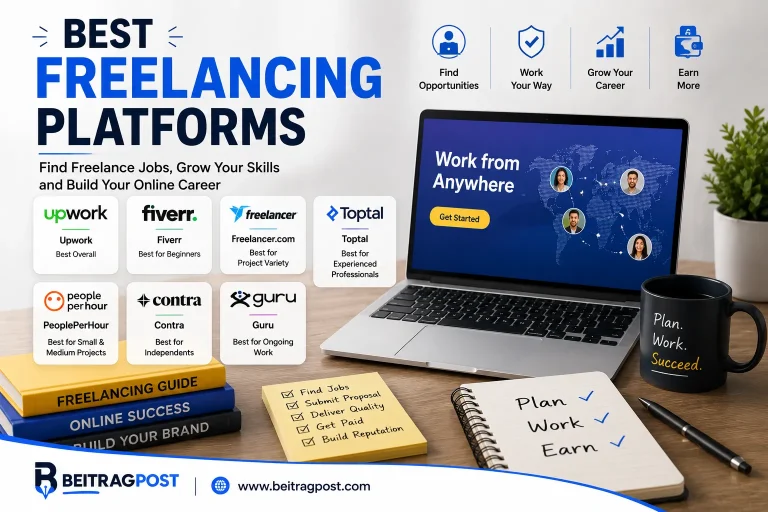
- Upwork — best for professional long-term client relationships and hourly contracts
- Fiverr — best for defined service packages at fixed prices
- Toptal — best for experienced developers and designers commanding premium rates
- PeoplePerHour — strong European client base
How to start freelancing — step by step:
Step 1 — Choose one specific skill to lead with. Not three. One. Generalists lose to specialists on every platform because buyers search for specific solutions, not general helpers.
Step 2 — Create profiles on two platforms. Complete every field. Add a professional photo, write a bio that speaks directly to client problems rather than listing your qualifications, and set your initial rate slightly below what you eventually want to charge.
Step 3 — Create two to three portfolio samples before you have real clients. If you are a writer, write two sample articles on topics relevant to your target clients. If you are a designer, create two mock projects. Buyers need to see capability before they take a chance on someone without reviews.
Step 4 — Send ten proposals in your first week. Not one. Not three. Ten. Study each job posting carefully before applying, and write a proposal that addresses the specific problem the client described rather than copying a generic template.
Step 5 — Price your first project at 20 to 30 percent below your target rate to land that first review. The first review is the hardest to get and the most valuable thing on your profile. Everything after it becomes easier.
Step 6 — Deliver work that exceeds what the client expected. Not just good work genuinely better than they anticipated. Ask for a review immediately after delivery while the positive experience is fresh.
Step 7 — Raise your rate by 15 to 20 percent after every five reviews. Do this consistently and your income grows automatically without finding higher-paying clients your existing profile quality attracts them.
Real example:
Marcus, a content writer from Texas, created his Upwork profile in January 2025 with no previous freelance clients. He offered blog posts at $0.06 per word below market rate to land his first three clients quickly. By month three he had 11 reviews and raised his rate to $0.12 per word. By month six he was charging $0.18 per word and earning $3,200 monthly working 25 hours per week. He never applied for a job after month four clients found him through his profile.
What real freelancers earn:
Upwork’s 2025 Skills Index shows AI and machine learning specialists averaging $45 to $95 per hour, web developers averaging $35 to $85 per hour, and copywriters averaging $25 to $75 per hour.
💡 Pro Tip:
Never compete with the lowest-priced freelancers on any platform. The clients who hire the cheapest option are also the most difficult to work with and the least likely to leave good reviews. Position yourself in the middle tier, deliver top-tier quality, and you will attract clients who value good work over the lowest possible price.
⚠️ Common Mistake:
Waiting for clients to come to you instead of actively sending proposals. New freelancers often create a profile, set it live, and then wait. Nothing happens because the platform has no reason to show a new profile with no reviews to buyers. Active outreach through proposals is the only thing that breaks this cycle in the early stages.
If you want to understand which freelancing tools make client management, invoicing, and project delivery more efficient, our guide on the best freelancing tools and platforms covers exactly that.
2. Virtual Assistant — Low Barrier, Immediate Demand
Virtual assistance is the fastest path to online income for people who do not yet have a specialized marketable skill. Businesses need help with tasks they do not have time for and they pay reliably for someone who shows up consistently, communicates clearly, and completes work accurately.
What is a virtual assistant?
A virtual assistant handles administrative and operational tasks remotely for a business owner, executive, or entrepreneur. The work ranges from basic email management to specialized support like bookkeeping, launch management, or executive coordination. The key advantage for beginners is that most VA tasks require organization and reliability more than specialized expertise.
Common VA tasks:
- Email inbox management, filtering, and organized responses
- Calendar scheduling and appointment coordination
- Customer inquiry handling and follow-up sequences
- Research and data compilation into usable formats
- Social media scheduling and basic content posting
- Document preparation, formatting, and proofreading
- Data entry and database management
How to start as a virtual assistant — step by step:
Step 1 — List every administrative task you are already competent at. Email management, scheduling, research, data entry, customer communication these are skills most people have from previous jobs or daily life that directly transfer to VA work.
Step 2 — Decide whether to work through an agency or find clients independently. Agencies like Belay, Time Etc, and Boldly handle client matching and provide steady work in exchange for taking a percentage of your rate. Independent clients pay more but require you to find them yourself.
Step 3 — If going independent, identify your target client. Small business owners, coaches, consultants, real estate agents, and e-commerce store owners are the most consistent VA hirers. They have too much administrative work and not enough time, but often cannot justify a full-time hire.
Step 4 — Create a simple one-page services document outlining what you offer, your availability, your rate, and two to three relevant examples of your organizational capabilities.
Step 5 — Reach out directly to five small business owners in your network this week. Not job boards — direct outreach to people whose businesses you are familiar with. A warm introduction converts dramatically better than a cold application.
Step 6 — Start with ten to fifteen hours per week for your first client at a rate you can justify based on the tasks involved. Demonstrate reliability for thirty days, then discuss expanding the arrangement or ask for a referral.
Real example:
Priya, a stay-at-home parent from Arizona, started VA work in March 2025 after her youngest child started school. She reached out directly to three small business owners she knew from her community a real estate agent, a nutritionist, and an online course creator. All three had immediate administrative needs. Within six weeks she was working twenty-two hours per week across the three clients, earning $1,980 monthly. By month four she raised her rate and replaced her lowest-paying client with a higher-paying one found through a referral.
What real VAs earn:
The International Virtual Assistants Association reports that experienced VAs in the United States earn $25 to $75 per hour, with specialized VAs in bookkeeping or executive assistance regularly commanding $50 to $100 per hour.
💡 Pro Tip:
Specialize as quickly as possible. General VAs compete on price. VAs who specialize in specific industries real estate, e-commerce, online coaching or specific tools Kajabi, ClickFunnels, HubSpot command 40 to 60 percent higher rates than general administrative assistants and face significantly less competition for the clients who need their specific expertise.
⚠️ Common Mistake:
Underpricing to get started and never raising rates. Many new VAs charge $12 to $15 per hour to land their first client and feel uncomfortable raising rates later because they fear losing the relationship. Set your starting rate at a level you can justify even if it is modest and build rate increases into your client agreements from the beginning rather than trying to negotiate them retroactively.
3. Online Tutoring — Knowledge You Have, Income You Are Not Earning Yet
If you have genuine expertise in any subject academic, professional, or creative there is a paying market for that knowledge. The global online tutoring market reached $13.8 billion in 2024 according to Grand View Research and continues expanding as students and professionals increasingly prefer learning through live sessions with real subject experts over recorded courses watched alone.
What subjects are in highest demand:
- Mathematics at all levels consistently the highest demand subject globally
- English language, writing, and grammar
- Science subjects biology, chemistry, physics
- Standardized test preparation SAT, ACT, GRE, GMAT, LSAT
- Programming, coding, and software skills
- Foreign languages Spanish, Mandarin, French, Arabic
- Music instruments and theory
- Business, accounting, and finance fundamentals
How to start tutoring online — step by step:
Step 1 — Identify the specific subject and level you can teach confidently. Being specific AP Chemistry rather than “science,” IELTS preparation rather than “English” attracts students with exactly that need and allows you to charge premium rates.
Step 2 — Create profiles on two tutoring platforms. Preply and iTalki for language tutoring. Tutor.com and Wyzant for academic subjects. Complete your profile with a genuine bio, relevant credentials or experience, and a clear description of who you help and how.
Step 3 — Record a short one to two minute introduction video for your profile if the platform allows it. Tutors with introduction videos on Preply receive 300 percent more trial lesson requests than those without, according to Preply’s published platform data.
Step 4 — Set your initial rate competitively not the lowest on the platform, but within the middle range for your subject. Starting too low signals low quality to buyers actively looking for effective tutors.
Step 5 — Prepare a structured first lesson format that demonstrates your teaching approach, assesses the student’s current level, and gives them something genuinely useful in the first session. Students who feel the first lesson was valuable book recurring sessions. Students who feel it was disorganized do not return regardless of subject expertise.
Step 6 — After each successful session, ask the student or their parent to leave a review. Early reviews are disproportionately important to profile visibility and booking rates on every tutoring platform.
Real example:
James, a mathematics teacher from Ohio, started tutoring on Wyzant in his evenings and weekends in February 2025. He specialized in SAT math preparation a specific, high-demand niche with parents willing to pay premium rates. He charged $65 per hour from the start based on market research. Within six weeks he had eight regular weekly students. By month three he was earning $2,080 monthly from sixteen tutoring hours per week without ever lowering his rate or accepting students outside his specialty.
What real tutors earn:
Wyzant’s published tutor data shows SAT preparation tutors averaging $65 per hour on the platform, with experienced tutors in AP calculus and organic chemistry regularly earning $80 to $120 per hour.
💡 Pro Tip:
Specialize in test preparation if you have the subject knowledge. Parents of students preparing for SAT, ACT, GRE, or GMAT exams are highly motivated buyers willing to pay premium rates because the stakes are high and the timeline is specific. Test prep tutors consistently earn 40 to 60 percent more per hour than general subject tutors on the same platforms.
⚠️ Common Mistake:
Trying to teach too many subjects to too many age groups. Tutors who list fifteen subjects across every grade level look unfocused to buyers and get passed over in favor of specialists who clearly know their specific area deeply. Pick two or three closely related subjects and own that niche completely.
4. Social Media Management — More Valuable Than Most People Realize
Most small businesses know they need consistent social media presence. Most of them lack the time, knowledge, or genuine interest to create content regularly and respond to their community. Social media managers fill that gap and in a market where every business owner has been told for five years that they need social media but most are still not doing it well, the demand is consistently higher than the supply of people who can deliver real results rather than just posting content without strategy.
What social media managers actually do:
- Create and schedule content across Instagram, Facebook, TikTok, LinkedIn, and Pinterest
- Write captions that reflect the brand voice and drive engagement
- Source, create, or direct creation of visual content
- Respond to comments and messages in the brand’s voice
- Track performance metrics monthly and adjust strategy based on what the data shows
- Run paid advertising campaigns for clients with dedicated budgets
How to start as a social media manager — step by step:
Step 1 — Choose one or two platforms to specialize in rather than offering everything. Instagram and TikTok for consumer brands. LinkedIn for B2B businesses. Facebook for local service businesses and older demographics. Specialists command higher rates and attract better clients than generalists who claim to do everything equally well.
Step 2 — Build a portfolio on your own accounts first. Manage your personal Instagram or create a demo account for a fictional brand. Document your results follower growth, engagement rates, reach improvements over sixty days. This becomes your proof of capability before you have paying clients.
Step 3 — Define your service packages clearly with specific deliverables, posting frequencies, platform coverage, and pricing. Ambiguous offerings lead to scope creep and difficult client relationships.
Step 4 — Reach out to five to ten local businesses whose social media you have already analyzed and identified clear improvement opportunities. Present specific observations about what they are doing, what is missing, and how you would approach it differently. This demonstrates expertise immediately and differentiates you from generic outreach.
Step 5 — Offer your first client a thirty-day trial at a reduced rate in exchange for a testimonial and case study if results are positive. Real results from one client become the proof that converts the next five.
Realistic client pricing:
- Basic package — 12 posts per month, one platform $300 to $600 monthly
- Standard package — daily posting, two platforms, engagement management $800 to $1,500 monthly
- Full management — multiple platforms, ads management, monthly strategy $1,500 to $3,000+ monthly
Real example:
Sofia, a marketing graduate from Florida, built her first social media management client base in 2025 by cold-emailing fifteen local restaurants with a specific observation about each one “Your food photography is strong but your posting frequency dropped 60 percent in the last three months, which is suppressing your reach.” Three responded. She signed two at $600 per month each. Within ninety days she had four clients at an average of $750 per month, earning $3,000 monthly working approximately twenty-five hours per week.
💡 Pro Tip:
Lead with analytics in your pitch, not creativity. Most business owners do not respond to “I can make your social media look better.” They respond to “Your engagement rate dropped 40 percent in the last quarter and here is specifically why.” Data-driven pitches convert dramatically better than aesthetic-focused ones because they speak the language business owners actually care about.
⚠️ Common Mistake:
Taking on too many clients before building systems and processes. Social media management without scheduling tools, content calendars, and approval workflows becomes overwhelming very quickly. Set up your systems before your third client not after your seventh.
5. Online Consulting — Highest Income Ceiling on This Entire List
Consulting translates professional expertise built over years into premium rates that service-based freelancing rarely reaches. The fundamental difference is this freelancers sell time, consultants sell outcomes. A consultant who helps a business solve a $200,000 problem commands fees that reflect that value rather than hours worked.
What is consulting and who can do it?
Consulting means advising businesses or individuals on how to solve specific problems using expertise you have developed through direct experience. You do not need a consulting firm background or an MBA. You need genuine expertise in a specific area and the ability to communicate that expertise in terms of business outcomes rather than technical processes.
High-demand consulting niches right now:
- Marketing strategy and customer acquisition
- Financial planning and fractional CFO services for growing businesses
- HR, hiring systems, and organizational development
- Technology implementation and digital transformation
- Business operations and process efficiency
- AI strategy and implementation — the highest demand niche in 2025 to 2026
How to start consulting — step by step:
Step 1 — Define your specific expertise and the specific problem you solve. Not “I help businesses with marketing” I help e-commerce businesses with $500K to $2M in revenue reduce their customer acquisition costs through email marketing and retention systems.” Specificity is what separates a consultant from someone who just has opinions.
Step 2 — Identify twenty businesses that have exactly the problem you solve. Research them specifically their revenue range, their current approach to the problem, the gaps you can see from the outside.
Step 3 — Reach out directly to decision-makers founders, COOs, VPs of Marketing through LinkedIn with a message that demonstrates you have already thought about their specific situation rather than sending a generic pitch about your services.
Step 4 — Offer a free sixty-minute strategy session for your first three to five prospects. Use this session to demonstrate the depth of your thinking, not to give away everything to show the prospect what working with you would feel like. Most prospects who experience a genuinely valuable free session want to continue the engagement at full rates.
Step 5 — Structure your engagement as a project with a defined scope and outcome rather than hourly billing. “I will help you build an email retention system that reduces churn by 15 to 20 percent over ninety days project fee of $6,000” is more compelling than “$150 per hour for as long as it takes.”
Real example:
David, a former marketing director at a mid-sized e-commerce company, left his role in 2024 and started consulting independently. He identified that direct to consumer brands between $1M and $5M in revenue consistently struggled with customer retention a problem he had solved internally multiple times. He reached out to fifteen brand founders on LinkedIn with specific observations about their retention metrics. Three booked discovery calls. Two became clients at $4,500 per month each. Within six months he had four clients, a waiting list, and was earning more than twice his previous salary working thirty hours per week.
What real consultants earn:
Independent consultants in the United States charge an average of $150 to $350 per hour for specialized expertise. Technology and AI consultants frequently command $250 to $500 per hour. A consultant working twenty billable hours per week at $200 per hour earns $16,000 monthly while maintaining full schedule control.
💡 Pro Tip:
Productize your consulting into a defined package rather than selling open-ended hourly engagements. “The 90-Day Revenue Retention System $6,000” is easier to sell, easier to deliver, and easier to scale than “consulting at $150 per hour.” Defined deliverables attract more serious clients and allow you to run multiple engagements simultaneously without scope creep consuming your capacity.
⚠️ Common Mistake:
Undercharging because imposter syndrome makes premium rates feel unjustified. Most first-time consultants charge 40 to 60 percent below what the market would pay for their expertise because they are comparing themselves to other consultants rather than to the value of the problem they solve. Price based on the outcome delivered, not the hours worked.
6. SEO Services — Every Business With a Website Needs This
Every business that has a website wants to rank higher in search results. Most of them have no clear idea how to make that happen, and the ones that do often lack the time to execute consistently. SEO professionals who can demonstrate real ranking improvements retain clients for months or years because the value of organic traffic is ongoing, measurable, and directly tied to revenue.
What is SEO and why do businesses pay for it?
SEO — search engine optimization is the process of improving a website’s visibility in Google and other search engines so more potential customers find it without paid advertising. A business ranking on page one of Google for a valuable keyword receives free traffic every day indefinitely. That ongoing value is why businesses pay monthly retainers for SEO rather than one-time fees the work compounds over time rather than stopping when the budget runs out.
SEO services with consistent demand:
- Keyword research and content strategy development
- Technical SEO audits — site speed, crawlability, indexing issues
- On-page optimization for existing content
- Link building and digital PR outreach
- Local SEO for location-based businesses
- Monthly strategy management and reporting
- SEO content writing and optimization
How to start offering SEO services — step by step:
Step 1 — Learn the fundamentals before selling anything. SEMrush Academy, Ahrefs Academy, and Google’s own Search Central documentation are all free and comprehensive. Spend four to six weeks genuinely understanding technical SEO, keyword research, and on-page optimization before approaching clients.
Step 2 — Apply what you learn to your own website or blog first. Real results from your own site become your most credible portfolio piece you can show prospects exactly what you did and what changed in the rankings.
Step 3 — Offer one free or heavily discounted SEO audit to a local business you know. Document everything you find, present it clearly, and show the business owner specifically what fixing these issues would mean for their traffic and leads. This audit becomes your case study.
Step 4 — Define your service packages clearly. An SEO audit is a one-time deliverable. Monthly SEO management is an ongoing retainer. Content strategy is a project. Having clear defined services prevents scope creep and makes pricing conversations straightforward.
Step 5 — Approach local businesses in competitive niches lawyers, dentists, contractors, real estate agents who have high customer values and clearly need better Google visibility. These businesses understand the value of ranking well because a single new client from search can be worth thousands of dollars.
Step 6 — Report results monthly in plain language. Not technical jargon about domain authority and crawl budgets “your website now appears on page one of Google for three new search terms that your ideal customers use, and your organic traffic increased 34 percent compared to last month.” Clients who understand their results renew. Clients who receive confusing technical reports cancel.
Real example:
Kevin, a digital marketing enthusiast from Chicago, spent two months learning SEO through free resources in early 2025. He applied what he learned to his personal blog and documented a 280 percent traffic increase over four months. He used that case study to approach five local law firms a niche where ranking well is worth thousands of dollars per new client. Two signed monthly retainer agreements at $1,200 per month. Six months later he had six clients at an average of $1,400 per month, earning $8,400 monthly while still working part-time hours.
Realistic pricing:
- One-time SEO audit — $500 to $3,000 depending on site size and depth
- Monthly SEO management — $750 to $3,000 per client
- Content-focused SEO retainers — $1,500 to $5,000 monthly
- Local SEO packages — $500 to $1,500 monthly
💡 Pro Tip:
Specialize in local SEO for high-value service businesses — lawyers, medical practices, contractors, real estate agents. These businesses have high customer lifetime values, consistently underinvest in SEO compared to what the results are worth, and rarely have internal marketing teams sophisticated enough to evaluate your work critically. Three local SEO clients at $1,000 per month each produces $3,000 monthly part-time income with relatively straightforward deliverables compared to enterprise SEO.
⚠️ Common Mistake:
Promising ranking results on specific timelines. SEO results depend on factors outside your control — Google’s algorithm updates, competitor activity, domain age, and content quality all affect outcomes in ways no SEO professional can guarantee. Promise deliverables audits completed, content published, links built, reports delivered never specific ranking positions by specific dates. Clients who feel misled by ranking guarantees become the most damaging reviews a service provider can receive.
7. AI-Assisted Services — Fastest Growing Category Right Now
Offering services enhanced by AI tools is one of the newest and fastest growing online income categories in 2026. The model is straightforward use AI to multiply your output speed and quality while maintaining human creative direction and quality control that clients genuinely need. This is not about replacing skill with AI it is about using AI to multiply the output of existing skill dramatically.
Why this opportunity exists right now:
Most businesses want to use AI to improve their operations but do not know which tools to use or how to use them effectively for their specific situation. A person who understands both a client’s industry and how to deploy AI tools to solve specific business problems commands consulting rates, not standard freelance rates. The gap between available AI capability and business adoption is enormous and that gap represents real income opportunity for people who bridge it.
Services where AI creates a meaningful advantage:
- AI-assisted content writing producing 3 to 5 times the output volume at maintained quality
- AI-enhanced video editing using tools like Descript and CapCut AI
- AI-powered research, competitive analysis, and business reports
- AI-generated design concepts refined with human creative judgment
- AI-assisted SEO content strategy and execution at scale
- AI implementation consulting helping businesses adopt specific tools for specific workflows
How to start — step by step:
Step 1 — Master two to three AI tools deeply rather than knowing ten tools superficially. ChatGPT and Claude for content and research. Midjourney or Adobe Firefly for image generation. Descript for video. Deep knowledge of fewer tools is more valuable to clients than surface knowledge of many.
Step 2 — Identify a specific service you can deliver faster and better using AI than competitors deliver without it. Content production is the most obvious a writer using AI to research, outline, draft, and edit can produce content in one quarter of the time and charge 50 percent less than traditional rates while still earning significantly more per hour than before.
Step 3 — Build a portfolio showing before and-after what the output looks like without AI assistance versus what you deliver with it. Speed, volume, and quality comparisons are compelling to business clients evaluating whether to hire you.
Step 4 — Target businesses that already understand they have a content or creative volume problem. Marketing agencies overwhelmed with client work, e-commerce brands needing product descriptions at scale, SaaS companies needing blog content consistently these are buyers who feel the pain you solve and understand its cost.
Step 5 — Be transparent with clients about using AI in your workflow. Position it as a capability advantage “I use professional AI tools to research and structure content efficiently, which allows me to deliver higher volume at better rates than traditional approaches.” Most clients respond positively to transparency about modern professional tools.
Real example:
Aisha, a content writer from New York, integrated AI tools into her writing workflow in early 2025. She could produce four high-quality 1,500-word articles per day compared to one previously. She lowered her per-article rate by 20 percent to stay competitive on price, but her daily earnings quadrupled because of volume. And then She shifted her positioning from writer to content strategist using AI for production while charging premium rates for strategic oversight, editorial judgment, and brand voice consistency. Her monthly income went from $2,400 to $9,600 in eight months.
💡 Pro Tip:
Position yourself as an AI implementation consultant rather than just a service provider who uses AI. Businesses will pay $150 to $300 per hour for someone who can assess their specific workflows, identify where AI tools would deliver the most value, implement those tools with their team, and train their staff to use them effectively. This is a genuinely new profession with almost no competition and enormous demand in 2026.
⚠️ Common Mistake:
Relying entirely on AI output without genuine human editorial judgment. AI tools produce content that requires experienced human review to catch errors, improve nuance, ensure accuracy, and maintain brand voice consistency. Clients who receive unreviewed AI output which is often detectable in its patterns and occasionally factually incorrect lose trust quickly. Your value is the judgment you apply to AI output, not the AI output itself.
Our guide on the best AI tools for beginners covers exactly which tools deliver real professional value for online income work and which ones are overhyped for actual client applications.
8. Selling Digital Products — Create Once, Sell Forever
Digital products represent some of the highest-margin income available online because you create them once and sell them indefinitely without inventory, shipping, or manufacturing costs. The economics are fundamentally different from physical products or service income your earnings are not capped by your available hours.
What is a digital product?
A digital product is any file or access that can be delivered electronically after purchase templates, ebooks, courses, presets, design assets, planners, spreadsheets, or software tools. The products that sell consistently are not the ones that sound impressive to create they are the ones that save buyers measurable time or solve a specific frustration they are actively experiencing and willing to pay to resolve.
Digital products with consistent demand:
- Notion and Canva templates for specific professional workflows
- Financial planning templates in Excel or Google Sheets
- Photography and video presets that save editing time
- Ebooks distilling expertise into actionable step-by-step guidance
- Online courses built around specific, measurable skill outcomes
- Printable planners and organizational worksheets for specific life areas
- Email templates and marketing swipe files for business owners
- Website themes and design assets for specific platforms
How to create and sell digital products — step by step:
Step 1 — Identify a specific problem your target buyer has that can be solved with a file or resource. The best digital product ideas come from questions people repeatedly ask in online communities, comment sections, and forums related to your area of expertise. If twenty people have asked the same question this month, a product that answers it thoroughly has a real market.
Step 2 — Research competing products before creating anything. Search Etsy, Gumroad, and Creative Market for similar products. Look at what exists, what reviews praise, what reviews criticize, and what seems to be missing. Build a product that is meaningfully better than what is currently available rather than a replica of it.
Create and Launch Your Product
Step 3 — Create the product with genuine care for the buyer experience. A Notion template that is confusing to navigate will generate refund requests and negative reviews regardless of how good the underlying system is. Clear instructions, clean design, and thoughtful organization determine whether buyers feel they got value.
Step 4 — Choose your primary selling platform based on where your target buyers already shop. Etsy for templates and printables. Gumroad for digital downloads of all types. Creative Market for design assets. Teachable or Thinkific for structured courses. Amazon KDP for ebooks. Each platform brings existing traffic start where your buyers already are rather than building your own store before you have proof of demand.
Price, Collect Reviews, and Grow
Step 5 — Price based on value delivered rather than time spent creating. A Notion template that saves a freelancer ten hours of setup time is worth $47 regardless of whether it took you two hours or twenty hours to create. Research competitor pricing, consider the buyer’s alternative doing it themselves or hiring someone and price accordingly.
Step 6 — Generate your first reviews by offering the product to five to ten people in your target audience for free in exchange for honest feedback. Reviews on digital product platforms are disproportionately important to conversion rates products with zero reviews convert at a fraction of the rate of products with ten positive reviews.
Real example:
Jennifer, a project manager from Seattle, created a set of Notion templates for freelancers in 2024 a client onboarding system, a project tracking dashboard, and an invoice tracker. She spent three weekends building them, priced the bundle at $37 on Gumroad, and shared them in three freelancer Facebook groups where she was already an active member. In the first month she sold 47 bundles $1,739 in revenue from work she had already completed. By month six the templates were generating $2,800 to $3,400 monthly passively with no additional work beyond occasional customer support emails.
💡 Pro Tip:
Create a small free version of your product a single template from a bundle, one chapter of an ebook, a lite version of a course and distribute it freely in communities where your target buyers spend time. People who experience the quality of your free version convert to paid products at dramatically higher rates than cold buyers who have never encountered your work. Free lead magnets that demonstrate genuine quality are the most efficient marketing for digital products.
⚠️ Common Mistake:
Creating a product nobody searched for. Many digital product creators build what they find interesting or impressive rather than what their target buyer is actively looking for. Before spending time creating anything, search for the problem your product solves on Google, Etsy, and relevant community forums. If people are not already searching for a solution, they are unlikely to buy yours regardless of its quality.
9. Affiliate Marketing — Earn From Recommending Products You Already Know
Affiliate marketing means earning a commission when someone buys a product through your recommendation link. You handle no products, manage no inventory, and deal with no customer service. Your job is creating genuinely helpful content and recommending the right products within it in ways that serve your audience’s interests rather than just your commission potential.
How affiliate commissions actually work:
- Amazon Associates pays 1 to 10 percent depending on product category
- Software affiliate programs frequently pay 20 to 40 percent recurring commission meaning you earn every month a referred customer maintains their subscription
- High-ticket programs for financial products, web hosting, and SaaS tools pay $50 to $500 per referral
- A content site with 10,000 monthly readers focused on software tools might earn $2,000 to $5,000 monthly from affiliate commissions once established and trusted by its audience
How to start affiliate marketing — step by step:
Step 1 — Choose a specific niche where you have genuine knowledge or strong interest. Affiliate marketing requires creating content that demonstrates real expertise readers and viewers who sense you do not actually know your subject click away rather than through your links.
Step 2 — Build a content platform first a blog, a YouTube channel, a newsletter, or a social media presence before joining affiliate programs. Affiliate programs have no value without an audience to share recommendations with, and building that audience takes time regardless of which content format you choose.
Step 3 — Join affiliate programs for products you genuinely use and would recommend regardless of the commission. Amazon Associates is the easiest to join and covers almost every physical product. ShareASale, Impact, and CJ Affiliate aggregate programs from thousands of companies. Individual software company programs hosting providers, email marketing tools, SaaS platforms — often pay the highest commissions.
Step 4 — Create content specifically designed to help people make purchasing decisions — honest product reviews, comparison articles between competing options, buying guides for specific use cases, and tutorials that naturally lead to product recommendations. Content that genuinely helps buyers make better decisions converts dramatically better than content that feels like a sales pitch.
Step 5 — Disclose affiliate relationships clearly and consistently. Beyond being legally required in most jurisdictions, transparency builds the reader trust that makes affiliate marketing sustainable long-term. Audiences who trust your recommendations buy through your links. Audiences who suspect you recommend products for commissions rather than genuine value click away.
Step 6 — Track which content converts and why. Most affiliate marketers earn 80 percent of their commissions from 20 percent of their content. Identify what is working, create more content in that pattern, and update underperforming content before creating new articles.
Real example:
Tom, a software developer from Canada, started a blog reviewing project management tools in 2023 a niche he knew deeply from his professional experience. He published two articles per week consistently for fourteen months before his traffic became meaningful. By month eighteen, his site received 35,000 monthly visitors and earned $4,200 per month from affiliate commissions primarily from project management software programs paying recurring monthly commissions. He had a full-time job throughout this period. The blog now earns whether he publishes new content or not.
What affiliate income actually looks like over time:
Most affiliate sites earn less than $200 per month in their first year. Income accelerates significantly in year two as content indexes and rankings compound. Established sites in valuable niches with strong content libraries often reach $3,000 to $15,000 monthly in years three to five.
💡 Pro Tip:
Prioritize affiliate programs with recurring commissions over one-time payouts whenever possible. A software tool paying 30 percent recurring commission on a $99 monthly subscription earns you $29.70 every month that customer maintains their subscription potentially for years from a single referral. Ten such referrals produce $297 monthly recurring income that grows without additional work each time a new customer signs up through your existing content.
⚠️ Common Mistake:
Choosing affiliate products based on commission rates rather than genuine quality and relevance. Recommending products you would not personally use, or products that do not genuinely match your audience’s needs, produces low conversion rates and damages the reader trust that makes affiliate marketing work long-term. The most successful affiliate marketers earn more from fewer, better-matched recommendations than from promoting everything with a commission attached.
10. Blogging — Slow to Start, Strong Compounding Over Time
A blog with fifty well-researched articles ranking in Google earns more each month than a blog with five articles and the income compounds as more content indexes and ranks. The compounding nature is what makes blogging worth the patience it demands, despite the slow and often discouraging early months when it seems like nothing is working.
What is blogging income and where does it actually come from?
Most successful bloggers do not rely on any single revenue stream. Income comes from multiple sources that stack on top of each other display advertising, affiliate commissions, sponsored content, and their own digital products or courses all contributing simultaneously.
How bloggers make money:
- Display ads through Mediavine requires 50,000 monthly sessions minimum pays $15 to $35 per 1,000 visitors in most niches, significantly more in finance and technology niches
- Affiliate commissions on products honestly reviewed and recommended within articles
- Sponsored posts from brands relevant to the blog’s niche and audience
- Digital products ebooks, courses, templates sold to an audience that already trusts the blogger’s expertise
How to start a blog — step by step:
Step 1 — Choose a niche specific enough to establish clear authority but broad enough to support hundreds of articles. “Personal finance for millennials” is better than “personal finance” more specific and better than “personal finance for millennial women in New York City earning over $100,000” — too narrow to sustain a content library.
Step 2 — Set up your blog on WordPress.org with reliable hosting. WordPress powers 43 percent of all websites on the internet and offers the most flexibility, plugin ecosystem, and SEO control of any blogging platform. Avoid free platforms like WordPress.com or Wix for a serious monetizable blog the limitations on customization and monetization become frustrating quickly.
Build a Strong Content Foundation
Step 3 — Research keywords before writing anything. Every article should target a specific search query that real people type into Google with enough monthly search volume to be worth pursuing and enough realistic ranking possibility for a new site to compete. Google Search Console, Ahrefs, and SEMrush all provide keyword research capabilities Ahrefs offers a limited free tool specifically for this purpose.
Step 4 — Publish consistently for the first twelve months regardless of traffic. Most bloggers quit during this phase because they publish twenty articles, receive minimal traffic, and conclude that blogging does not work. In reality, Google takes several months to fully evaluate new websites and new content. Consistency during this low-traffic phase is what separates bloggers who eventually succeed from those who quit before their content has had a realistic chance to rank.
Improve SEO and Monetize Your Blog
Step 5 — Build internal linking throughout your content library from the beginning. Every new article should link to two to three existing articles on related topics. Internal linking helps Google understand the relationship between your content and improves rankings across your entire site simultaneously.
Step 6 — Apply to Mediavine or AdThrive once you reach their traffic thresholds. Both networks pay dramatically more per visitor than Google AdSense often five to ten times more which is why reaching their minimums is a significant income milestone for bloggers.
Real example:
Rachel, a personal finance enthusiast from Georgia, started a blog focused on debt payoff strategies for people in their 30s in January 2024. She published two articles per week consistently and reached 52,000 monthly sessions by month fourteen qualifying her for Mediavine. Her Mediavine income alone was $2,100 in the first month. Combined with affiliate commissions from financial tools she recommended, her blog earned $3,800 in month fifteen. By month twenty she was earning $6,400 monthly from a site that operated almost entirely on autopilot between her weekly new article.
What real bloggers earn:
Income School’s 2025 blogger survey of 1,000 bloggers found that blogs in their third year averaged $1,847 monthly. Blogs in their fifth year averaged $5,200 monthly. Finance and software niches earned significantly above average with top performers in those niches reporting $15,000 to $50,000 monthly from established sites.
Niches that earn well:
- Personal finance and investing — highest RPM of any common niche
- Software reviews and comparisons — high affiliate commissions plus strong advertiser demand
- Health and fitness — broad audience, strong advertiser interest
- Home improvement — high purchase intent, strong affiliate opportunities
- Pet care — passionate audience, consistent advertiser demand
💡 Pro Tip:
Write comparison articles between competing products in your niche as a priority content type. “Product A vs Product B” searches have extremely high commercial intent the person searching is actively deciding between two options and ready to buy. These articles convert to affiliate commissions at dramatically higher rates than informational articles and often rank faster because fewer competitors target the specific comparison query.
⚠️ Common Mistake:
Publishing without keyword research and hoping quality alone drives traffic. The best-written article in the world earns zero traffic if it does not target a search query people are actually using. Every article you publish represents a significant time investment — keyword research before writing ensures that investment has a realistic chance of generating returns rather than disappearing into a search results page nobody ever reaches.
11. YouTube — Highest Ceiling, Longest Runway
YouTube crossed 2.7 billion monthly users in 2025. The platform pays creators through AdSense once channels reach 1,000 subscribers and 4,000 watch hours but ad revenue alone rarely produces serious income for most channels. The real money comes from sponsorships, affiliate links, and creators’ own products and services promoted to an audience that already trusts them.
What makes YouTube different from every other method on this list:
YouTube is the only platform where a single piece of content can generate income for years after it is published. A video that ranks well in YouTube search or gets recommended by the algorithm keeps earning views and therefore income indefinitely. That long-tail earning potential is what separates YouTube from social media platforms where content typically earns most of its reach within the first 48 hours of posting.
What average YouTube earnings actually look like:
AdSense pays roughly $2 to $5 per 1,000 views in most niches. A video reaching 100,000 views earns $200 to $500 from ads alone. Finance, technology, and business channels consistently command the highest CPMs sometimes $15 to $30 per 1,000 views because advertisers in those niches pay premium rates to reach those audiences.
The same channel earning $1,000 monthly from AdSense with a single $5,000 brand sponsorship per month and $800 in affiliate commissions earns $6,800 monthly from the same audience. That multiplier effect AdSense as the baseline, sponsorships and affiliates as the real income is how successful YouTubers actually earn what their income reports show.
How to start a YouTube channel — step by step:
Step 1 — Choose a specific niche with both audience demand and monetization potential. Technology reviews, personal finance, career advice, cooking for specific dietary needs, fitness for specific demographics specific beats general on YouTube because specific channels build more loyal audiences and attract more relevant sponsorships.
Step 2 — Research your niche before publishing your first video. Watch the top 20 videos on topics you plan to cover. Understand what existing channels do well, what gaps exist, and where you can offer a genuinely different or better perspective. Starting without this research means competing directly against established channels without a differentiating angle.
Create High-Quality Content Consistently
Step 3 — Invest in audio quality before anything else. Viewers forgive average video quality far more readily than they forgive poor audio. A $50 USB microphone dramatically improves perceived production value more than a $500 camera upgrade. Sound quality is the single highest-return equipment investment for new YouTubers.
Step 4 — Publish your first ten videos before evaluating results. Ten videos provide enough data to understand which topics resonate, which formats hold viewer attention, and which thumbnails and titles drive clicks. Evaluating after two or three videos is like judging a restaurant after tasting one dish on a bad day.
Analyze Performance and Monetize
Step 5 — Study your analytics after every video with genuine curiosity rather than just checking view counts. Average view duration, click-through rate on thumbnails, traffic sources, and subscriber conversion rate all tell you specific things about what is working and what needs adjustment. Channels that improve based on data grow faster than channels that publish consistently without reflecting on performance.
Step 6 — Reach YouTube Partner Program eligibility 1,000 subscribers and 4,000 watch hours — before pursuing sponsorships. Brands occasionally work with smaller channels but most require Partner Program status as minimum credibility. Focus entirely on content quality and consistency until you reach this milestone.
Real example:
Daniel, a software engineer from Toronto, started a YouTube channel explaining complex programming concepts in plain English in 2024. He published one video per week consistently — not two or three, just one done well for sixteen months. At month sixteen his channel had 23,000 subscribers, 180,000 monthly views, and was earning $720 monthly from AdSense. His first brand sponsorship from a coding education platform paid $3,200 for one video. His total channel income that month was $4,100 more than he had earned from the channel in its first year combined. He now earns $7,000 to $11,000 monthly from a channel he manages in approximately fifteen hours per week.
💡 Pro Tip:
Design every video to rank in YouTube search rather than relying on the algorithm to recommend it. Search-optimized videos earn views indefinitely sometimes for years after publication. Recommended videos earn most of their views in the first week and then decline. A library of fifty search-optimized videos earns compounding baseline income that grows every time you add a new video a completely different economic model from chasing viral content that burns bright and disappears.
⚠️ Common Mistake:
Prioritizing production quality over content substance in the early stages. New YouTubers frequently spend their first three months setting up the perfect studio, researching the best camera, and designing channel art then publish their first video six months after deciding to start. The channels that grow fastest start publishing imperfect videos immediately and improve with every upload. Your tenth video will be dramatically better than your first regardless of how much equipment you own.
12. Print on Demand — Creative Income Without Inventory Risk
Print on demand lets you sell physical products featuring your original designs without managing inventory, handling fulfillment, or carrying any financial risk on unsold stock. When a customer orders, the platform prints the item and ships it directly. You keep the margin between your selling price and the platform’s base production cost.
What is print on demand and why does it work?
Print on demand works because it eliminates the two biggest barriers to selling physical products online upfront inventory investment and fulfillment logistics. You can test a design idea with zero financial risk and unlimited design quantity, which means the only real investment is your time creating designs that might or might not sell.
Products you can sell:
- T-shirts, hoodies, sweatshirts, and hats
- Mugs, water bottles, and tumblers
- Phone cases for major device models
- Tote bags and backpacks
- Wall art, posters, and canvas prints
- Stickers, magnets, and keychains
- Notebooks and journals
- Throw pillows and blankets
How to start with print on demand — step by step:
Step 1 — Choose your design approach. You do not need to be a professional designer many successful print on demand sellers use Canva, Adobe Express, or simple text-based designs. What matters is whether your design resonates with a specific audience, not whether it demonstrates technical design sophistication.
Step 2 — Research your niche before creating designs. Browse Redbubble and Etsy for your intended niche, look at what is selling well in the bestseller sections, read reviews of popular products, and identify gaps designs that your target audience clearly wants but that existing sellers are not providing well.
Create and Launch Your First Collection
Step 3 — Create ten to fifteen designs targeting a specific niche before listing anything. Launching with a small, cohesive collection in a specific niche looks more professional to buyers and gives you enough product variety to see which design styles and topics connect with your audience.
Step 4 — Choose your platform based on your goals. Redbubble and Merch by Amazon provide built-in marketplace traffic buyers find your products through searches on the platform without you needing to market them. Printful or Printify connected to your own Shopify store gives you higher margins and full brand control but requires you to drive your own traffic.
Optimize and Scale Your Store
Step 5 — Write product titles and descriptions with genuine keyword research. On Etsy and Redbubble, products are discovered through search your title and tags determine whether buyers find your design or a competitor’s. Research what terms your target buyers actually use when searching and incorporate those terms naturally.
Step 6 — Publish consistently for at least ninety days before evaluating results. Print on demand is a volume and iteration game the more quality designs you have listed, the more chances you have of finding the ones that resonate. Sellers with 500 designs earn meaningfully more than sellers with 50 designs in the same niche, all else being equal.
Real example:
Miguel, a graphic design student from California, started a Redbubble store in 2024 focused entirely on hiking and outdoor adventure designs a niche he was genuinely passionate about and knew well. He published three to four designs per week for four months building a catalog of 58 designs. Monthly sales in month one were $47. Month four brought $340. By month eight, with 140 designs live, his store earned $1,100 monthly in passive income. He had not published a new design in six weeks when that payment arrived.
💡 Pro Tip:
Target passionate niche communities rather than broad general audiences. A design that perfectly captures an inside reference for competitive crossword puzzle enthusiasts will consistently outsell a generic “I love coffee” design despite targeting a fraction of the audience because passionate niche communities actively seek merchandise that reflects their specific identity and are willing to pay for designs that speak their language precisely. The more specific and accurate your niche targeting, the higher your conversion rate.
⚠️ Common Mistake:
Creating designs you personally like rather than designs your target audience is actively searching for. Print on demand success is driven by demand research, not artistic preference. A design you find boring but that perfectly matches what a specific community is searching for will outsell a design you are proud of but that targets no specific buyer consistently. Research before creating always.
13. Dropshipping — Lower Risk Than Traditional Retail
Dropshipping allows selling physical products online without holding inventory or managing fulfillment. When a customer orders from your store, your supplier ships the product directly to them. You keep the difference between your selling price and the supplier’s cost. The model eliminates inventory risk and startup capital requirements that make traditional retail challenging.
What dropshipping actually involves:
Dropshipping is frequently described as passive or easy in online marketing content. It is neither. Successful dropshipping requires product research, store building, paid advertising management, customer service, and supplier relationship management. The advantage over traditional retail is not less work it is eliminated inventory risk and lower startup costs.
How to start dropshipping — step by step:
Step 1 — Choose a specific product niche rather than a general store. Niche stores stores focused on pet accessories, home gym equipment, or kitchen organization convert better than general stores because they build category authority and attract buyers with specific purchase intent rather than casual browsers.
Step 2 — Research products using tools like Minea, AdSpy, or simply browsing TikTok and Instagram ads to identify what is currently selling well. Look for products with genuine demand, healthy margins of at least 30 percent, and suppliers who can fulfill reliably not products that simply look interesting.
Step 3 — Source suppliers through AliExpress for testing products quickly, or through CJDropshipping and Zendrop for faster shipping times and better reliability once you have identified products worth scaling. Shipping time is one of the most common customer complaints in dropshipping choose suppliers who can deliver in reasonable timeframes for your target market.
Step 4 — Build a professional Shopify store. Your store needs to look credible and trustworthy — clear product photos, honest product descriptions, visible contact information, genuine return policy, and customer reviews. Stores that look hastily assembled convert poorly regardless of how good the product or advertising is.
Step 5 — Start advertising with a small daily budget $20 to $30 per day on Facebook, Instagram, or TikTok. Test multiple creative formats and targeting approaches before scaling any campaign. Most dropshipping beginners lose money initially on advertising while learning what their specific audience responds to budget this learning cost into your expectations from the start.
Step 6 — Scale advertising on campaigns that demonstrate profitable return on ad spend and cut campaigns that do not convert within their testing budget. Dropshipping profitability is entirely dependent on advertising efficiency stores that master this become profitable, stores that do not remain unprofitable regardless of product quality.
Real example:
Carlos, an entrepreneur from Texas, launched his first dropshipping store in 2025 focused on home organization products. His first two months were unprofitable he spent $1,400 on advertising and generated $900 in revenue while learning his audience’s response to different creative formats. In month three he found a product and creative combination that converted profitably. By month five his store was generating $12,000 in monthly revenue at a 22 percent net margin $2,640 profit monthly. He reinvested that profit into scaling the winning campaigns.
💡 Pro Tip:
Focus obsessively on your advertising creative rather than your product selection. Most dropshipping failures are advertising failures the right product presented with mediocre advertising loses to the mediocre product presented with exceptional advertising almost every time. Study what successful dropshipping ads look like, understand why they work psychologically, and invest the majority of your energy in creative quality before scaling any campaign.
⚠️ Common Mistake:
Choosing products based on personal interest rather than profit margin analysis. Many beginners build stores around products they find interesting without verifying that the margin between supplier cost and viable retail price is sufficient to cover advertising costs and still produce profit. Always calculate fully-loaded unit economics product cost, shipping, advertising cost per customer, platform fees, and payment processing before committing to any product.
14. Remote Customer Support — Immediate Income While You Build
Remote customer support positions provide immediate, reliable income for people who need to start earning online quickly while building other income streams in parallel. Many technology companies hire remote representatives to handle customer inquiries by phone, chat, or email from home often with flexible scheduling that accommodates other pursuits.
What is remote customer support?
Remote customer support means handling customer questions, complaints, technical issues, and order inquiries for a company from your home. The work varies from basic order tracking and FAQ responses to specialized technical troubleshooting depending on the company and role.
How to find and land remote customer support positions — step by step:
Step 1 — Create or update your resume specifically for remote customer support roles. Highlight any previous customer-facing experience retail, food service, administrative work communication skills, and familiarity with common customer support tools like Zendesk, Freshdesk, or Intercom.
Step 2 — Apply to five to ten positions per day rather than spending days perfecting applications for two or three. Remote customer support positions receive high application volumes your application is competing against many others and a moderate-quality application submitted quickly often outperforms a perfect application submitted slowly.
Step 3 — Target technology companies and SaaS businesses specifically for better pay, more flexible schedules, and more interesting work than retail or telecommunications customer support positions. Software companies generally pay $18 to $30 per hour for customer support compared to $13 to $16 per hour at traditional companies.
Step 4 — Research each company genuinely before interviewing. Customer support interviews frequently include scenario questions “how would you handle a customer who demands a refund outside our policy?” that reward understanding the company’s product and values. Candidates who clearly understand what the company does and why customers use it stand out immediately.
Step 5 — Once hired, treat the role as a learning opportunity beyond just the paycheck. Customer support gives you direct insight into what customers of a specific type of business actually struggle with which is valuable market research if you are building other income streams in parallel.
Where to find legitimate remote customer support positions:
- Remote.co and We Work Remotely remote-first company listings curated for quality
- FlexJobs vetted remote and flexible positions with no scam listings
- LinkedIn jobs filtered to remote customer service roles
- Direct applications to SaaS companies whose products you use and understand
- Indeed filtered to remote customer service with salary filters applied
Real example:
Maria, a recent graduate from Ohio, needed income immediately while building her freelance writing career. She applied to forty remote customer support positions over two weeks in early 2025 using Remote.co and direct company applications. And then She received three interviews and two offers one at $17 per hour and one at $21 per hour from a project management software company. She accepted the higher offer, worked thirty hours per week, and used her remaining time to build her writing portfolio. Six months later her writing income exceeded her customer support income and she transitioned fully to freelancing with six months of financial stability behind her.
💡 Pro Tip:
Apply specifically to customer support roles at companies whose products you personally use and genuinely understand. Your familiarity with the product shows immediately in interviews and makes you more effective from your first week which leads to better performance reviews, faster advancement, and the kind of genuine product knowledge that translates into better customer interactions and higher customer satisfaction scores.
⚠️ Common Mistake:
Treating remote customer support as a temporary embarrassment rather than a legitimate strategic choice. Many people in this role feel they are settling for something below their potential and put minimal effort into the work as a result. The income is real, the skills developed communication, conflict resolution, product knowledge, customer psychology are genuinely valuable, and the financial stability provides a foundation for building other income streams without desperation-driven decision making.
15. Stock Photography and Video — Passive After Upload
Shutterstock, Adobe Stock, Getty Images, and Pond5 pay contributors royalties every time their content is licensed by a buyer. Upload once and earn repeatedly sometimes for years as long as the content remains available in the marketplace. The income is genuinely passive after the initial creation and upload effort.
What is stock photography and video licensing?
When a business, publication, or individual needs a photo or video clip for commercial use website imagery, advertising, editorial content, social media they license it from a stock marketplace rather than commissioning custom photography. Contributors who supply that content earn a royalty percentage every time their file is licensed. A single high-quality image can earn royalties hundreds or thousands of times over its lifetime in the marketplace.
What actually sells in stock photography:
The stock marketplace is not short of generic sunset photos or beautiful landscapes. What buyers consistently search for and struggle to find is authentic, specific, commercially useful imagery that reflects real life rather than staged perfection.
Content with genuine commercial demand:
- Authentic diverse representation in workplace and professional contexts
- Remote work scenarios with current, realistic equipment and environments
- Small business operations retail, food service, skilled trades — in genuine settings
- Food and health content that feels real rather than over-styled
- Technology in use by real people not posed hands on keyboards
- Specific cultural celebrations and traditions represented authentically
- High-quality video clips for social media advertising production
How to build a stock photography income — step by step:
Step 1 — Research the specific gaps in your intended niche before shooting anything. Search your niche terms on Shutterstock and Adobe Stock. Look at what exists, what the top-selling images look like, and what buyer reviews and requests suggest is missing. Shoot to fill gaps rather than duplicating what is already oversupplied.
Step 2 — Create a consistent shooting schedule. Stock photography income scales with portfolio size contributors with 500 quality images earn meaningfully more than contributors with 50. Building to a substantial portfolio requires treating it as a consistent creative discipline rather than occasional uploads.
Step 3 — Submit to multiple platforms simultaneously. Shutterstock, Adobe Stock, Getty Images through iStock, Pond5 for video, and Alamy all accept contributor submissions. Being exclusive to one platform limits your income ceiling unnecessarily non-exclusive contributors earn from every platform their content appears on simultaneously.
Step 4 — Write accurate, thorough metadata for every file title, description, and keyword tags. Stock buyers find content through search, not browsing. A technically excellent photo with poor metadata earns no royalties because buyers never find it. Study how top-performing contributors in your niche write their metadata and apply similar approaches to your own submissions.
Step 5 — Track which content earns and why. After six months of consistent uploads, your earnings data will show clear patterns which subjects, lighting conditions, orientations, and content types earn the most royalties in your niche. Shift your shooting to produce more of what the data shows is working and less of what earns nothing.
Real example:
Lisa, a hobbyist photographer from Minnesota, started uploading to Shutterstock and Adobe Stock in 2023 focusing on authentic small business and remote work imagery a niche she identified as undersupplied through research. She uploaded 30 to 40 images per month consistently for fourteen months. In month one her total royalties were $23. In month six they reached $340. By month fourteen with 480 images across both platforms she earned $890 monthly in completely passive income without having uploaded anything new in the previous two months due to a busy personal schedule.
What real stock contributors earn:
Contributors with portfolios of 500 or more quality images earn $300 to $1,200 monthly in passive royalties according to Shutterstock contributor data. Contributors focused specifically on commercially valuable content business imagery, technology scenes, diverse lifestyle photography earn significantly above the platform average. Video contributors typically earn higher per-clip royalties than photo contributors because quality commercial video is less oversupplied than photography.
💡 Pro Tip:
Invest in video alongside photography from the beginning. Stock video clips typically earn three to five times more per license than equivalent photography because quality commercial video is significantly less oversupplied than photography across every major stock platform. A ten-second clip of someone paying with a contactless card at a small business can earn more in a month than fifty photos of the same subject. If you can capture quality video with the equipment you already own, prioritize it.
⚠️ Common Mistake:
Uploading everything you shoot without editorial judgment. Stock platforms penalize contributors whose acceptance rates drop below certain thresholds by reducing portfolio visibility in search results. Submit only your technically strongest images sharp focus, proper exposure, clean composition rather than uploading every frame from a shooting session. Quality over volume matters for platform standing even though volume matters for overall income.
The Online Income Statistics Worth Knowing
These numbers matter because they show the scale of what is actually happening not theoretical potential but documented economic activity across real platforms and markets.
The global freelance market reached $1.5 trillion in 2024 according to Staffing Industry Analysts larger than the GDP of most countries and growing at approximately 15 percent annually. Upwork processed $4.1 billion in freelancer earnings through its platform alone in 2024, representing only a fraction of total freelance economic activity since most experienced freelancers work directly with clients outside any platform.
The creator economy YouTube, podcasting, newsletters, social media, and digital products combined generated $250 billion in 2024 according to Goldman Sachs research. That figure is projected to reach $480 billion by 2027 as more people shift consumption and spending toward creator-produced content and away from traditional media.
Remote Work :
Remote work adoption has permanently shifted hiring patterns. LinkedIn reports that remote job postings attract 50 percent more applications than equivalent in-office positions, yet remote and hybrid positions now represent 20 percent of all job listings up from 4 percent in 2019. The structural shift toward location-independent work has created a permanent infrastructure of tools, platforms, and employer acceptance that did not exist five years ago.
Digital product sales on platforms like Etsy, Gumroad, and Creative Market grew 89 percent between 2022 and 2024. Online tutoring market size reached $13.8 billion globally in 2024 and is projected to reach $23.2 billion by 2028 according to Grand View Research. Stock content licensing generated over $4 billion in contributor royalties across major platforms in 2024.
What these numbers mean practically is simple. Real money is moving from buyers to sellers across every category on this list at scale, consistently, and in growing volumes. The question has never been whether online income is possible. It has always been which approach fits your specific situation and whether you will commit to it long enough to reach the compounding phase where effort and income begin to align.
Common Mistakes That Stop People Before They Get Started
Understanding what derails most online income attempts is as useful as understanding what works. These patterns appear so consistently across methods and demographics that they qualify as predictable and predictable problems can be avoided.
Switching methods every six weeks because progress feels slow
The first sixty to ninety days of any online income method feel discouraging. Traffic is low or nonexistent. Client responses are sparse. Sales are zero or minimal. This phase feels like evidence that the method does not work but it is actually the phase every successful online earner survived on the way to consistent income. The methods are not failing. The timeline expectations are wrong.
Choosing a method based on income potential rather than personal fit
YouTube has the highest income ceiling on this list. It also requires consistent on-camera comfort, video production skills, thumbnail design knowledge, and patience for a platform with one of the longest timelines to meaningful income. Someone who is genuinely uncomfortable on camera and impatient for results is not well-suited to YouTube regardless of its income potential and the method they abandon after three months generates zero income compared to a method with a lower ceiling that they actually pursue consistently for three years.
Pursuing three methods simultaneously before mastering one
Focus compounds faster than diversification when starting out. A person splitting time between a blog, an Etsy shop, and a Fiverr profile in their first six months is spreading the learning curve — and the critical mass of effort required — across three separate systems simultaneously. Each one gets one-third of the attention it needs to reach the point where it starts producing. Starting with one method and adding others only after the first is generating consistent income produces better results than parallel-starting everything.
Treating online income research as the work itself
Many people spend months reading about freelancing, watching videos about dropshipping, and researching blogging niches without ever creating a profile, listing a product, or publishing an article. Research is not income. The only thing that generates income is publishing, applying, listing, and reaching out and the optimal point to start doing those things is much earlier than most people feel ready for. You will never feel fully ready. Start before you feel ready and learn from real feedback rather than theoretical preparation.
Underestimating how long the learning curve actually takes
Every method on this list has a learning curve that most people underestimate by a factor of two to three. Freelancers expect to land consistent clients within thirty days and find it takes ninety. Bloggers expect meaningful traffic within six months and find it takes fourteen. YouTubers expect to reach monetization within three months and find it takes twelve. Accurate expectations about timelines — set before you begin rather than adjusted in frustration halfway through are the single most important mindset factor in online income success.
30-Day Beginner Action Plan — Start From Zero Today
This plan works for any method on this list. Adapt the specific tasks to whichever method you chose the structure applies universally.
Week 1 — Choose, Research, and Commit
Day 1: Use the decision tree and comparison table earlier in this article to choose one method. Write down why you chose it and what you expect from the first ninety days. Keep this document — you will want to read it during the discouraging moments in week eight.
Day 2 to 3: Spend four hours total researching the three most successful practitioners of your chosen method who are currently active. Not the people with the most followers or the most impressive income claims the ones whose approach seems most replicable and whose content seems most honest about what the work actually involves.
Day 4 to 5: Research the specific platforms, tools, and setup requirements for your method. Make a list of exactly what you need to start accounts to create, tools to learn, equipment to acquire and identify which of those things you can do for free or low cost right now.
Day 6 to 7: Complete all account creation, profile setup, and basic tool familiarization. Do not wait until everything is perfect. Done and imperfect outperforms perfect and never started in every online income category without exception.
Week 2 — Create Your First Sample Work
Day 8 to 10: Create your first practice deliverable a sample article if you are freelance writing, a demo design if you are doing graphic design, a sample social media plan if you are doing social media management, a prototype template if you are creating digital products. This is not for sale or clients yet it is for building your own confidence and identifying gaps in your capability.
Day 11 to 12: Get honest feedback on your practice work. Share it with one or two people who will tell you the truth rather than be encouraging. Honest feedback before your first real client interaction is valuable information. Honest feedback after a client has already paid for work they find disappointing is a negative review.
Day 13 to 14: Revise based on feedback and create one more practice piece incorporating what you learned. Two strong samples are enough to start do not use the need for a perfect portfolio as a reason to delay reaching out to real prospects.
Week 3 — First Real Outreach
Day 15 to 17: Make your first five outreach attempts to real potential clients, students, buyers, or employers depending on your method. Not passive actions like posting on social media and waiting active direct outreach to specific people or businesses with a specific, relevant offer.
Day 18 to 19: Analyze the responses or lack of responses from your first outreach attempts. What did you offer? How did you present it? What might a potential client have found unclear or uncompelling? Adjust your approach based on actual response patterns rather than assumptions.
Day 20 to 21: Make your next five outreach attempts with the adjusted approach. Ten total outreach attempts in week three is a realistic minimum not a maximum. More attempts create more data about what works and more chances of connecting with someone ready to move forward.
Week 4 — First Income
Day 22 to 25: Deliver your first project, make your first sale, or complete your first session whatever your method requires. Focus entirely on the quality of this first delivery. Your first client’s experience determines whether they return, refer others, and leave a positive review three outcomes that compound significantly over time.
Day 26 to 27: Request a review, testimonial, or written feedback immediately after delivery while the positive experience is fresh. Do not wait a week hoping they will leave one voluntarily most satisfied clients do not think to do this without a direct, genuine request.
Day 28 to 30: Use your first result however modest as social proof in your next five outreach attempts. “I recently helped [type of client] with [type of result]” is a fundamentally more compelling opening than “I can help you with [type of service].” Evidence of capability converts dramatically better than claims of capability.
What happens after 30 days:
Most people who follow this plan have their first online income within thirty days. Some will have their first client but not yet received payment. And Some will have made their first digital product sale. Some will have been hired for their first remote position. A few will still be in outreach mode waiting for their first yes.
What all of them have that they did not have thirty days ago is real-world feedback, actual experience with the process, and a foundation to build from. The second month is always easier than the first. The sixth month is always easier than the second. Momentum is real and it starts on day one, not on the day when conditions feel perfect.
How to Choose — Final Summary Table
| If you are… | Best Method | Why |
|---|---|---|
| A student | Online tutoring | Use existing academic knowledge immediately without startup costs |
| A designer or creative | Freelancing or Print on Demand | Monetize existing creative skills on proven platforms |
| A writer | Freelancing or Blogging | Writing skills transfer directly and demand is consistent |
| A stay-at-home parent | Virtual Assistant | Flexible hours, low barrier to entry, immediate demand |
| Working full-time | Affiliate Marketing or Digital Products | Build passively alongside existing employment |
| Need money this week | Remote Customer Support | Fastest hiring process with lowest entry requirements |
| An experienced professional | Consulting | Highest income ceiling, fastest path to premium rates |
| Tech-savvy beginner | AI-Assisted Services | Enormous demand, low current competition, growing rapidly |
| A photographer | Stock Photography or Freelancing | Monetize existing skill with passive income potential |
| Patient long-term builder | YouTube or Blogging | Compounding passive income worth the extended timeline |
Conclusion — The Only Mistake That Guarantees Failure
Every method on this list has produced full-time income for people who started with less experience, less time, and fewer resources than you currently have. Every method has also produced nothing for people who tried it without genuine commitment or abandoned it before the compounding phase kicked in.
The biggest mistake in online income is not choosing the wrong method. It is never committing to one long enough to find out whether it would have worked.
Pick one method today not tomorrow, not after more research, today. Follow the 30-day plan in this article. Give it three genuine months before evaluating. Your first online dollar matters infinitely more than another month of reading about how other people earned theirs.
The internet has never offered more legitimate ways to earn income from anywhere. The only question is whether you will start before you feel ready because that moment of feeling ready never actually arrives. It is replaced by a moment of looking back and being glad you started when you did.
FAQs — How to Make Money Online
What is the fastest way to make money online?
Freelancing, virtual assistance, and remote customer support produce income fastest typically within one to four weeks of active effort for people who pursue clients actively rather than waiting passively. Remote customer support is the fastest option for people starting with no specialized skills since many companies hire with minimal requirements and short onboarding periods. Freelancing is fastest for people with existing marketable skills who can demonstrate capability through portfolio samples.
How much can you realistically make online?
Income varies enormously by method, effort, and time invested. Freelancers with in-demand skills earn $2,000 to $8,000 monthly working part-time within their first year. Virtual assistants working twenty hours per week earn $1,500 to $3,000 monthly within sixty days of finding consistent clients. Established bloggers and YouTubers in profitable niches earn $5,000 to $30,000 monthly after three to five years of consistent work. Most methods produce modest income in the first six months and grow significantly in years two and three as skills, reputation, and systems compound.
Can I make money online without any investment?
Yes. Freelancing requires only skills and free platform accounts. Virtual assistance and tutoring require the same. Print on demand requires no inventory capital whatsoever. Affiliate marketing with a basic blog costs under $100 annually in hosting and domain fees. YouTube and social media content creation can begin with a smartphone you already own. The methods requiring the most startup investment dropshipping and YouTube with professional equipment still cost dramatically less than traditional brick-and-mortar business startup costs.
Can students make money online?
Absolutely. Online tutoring is particularly well-suited to students with strong academic knowledge — you can earn $40 to $80 per hour teaching subjects you already know while studying. Freelancing in writing, design, or social media management works well for students with creative skills developed through coursework or personal projects. Virtual assistance and remote customer support offer flexible part-time arrangements compatible with a student schedule. Many successful online income earners started building their income streams during their student years precisely because the flexible nature of academic schedules gave them time to experiment and iterate.
Is online income taxable?
Yes, in most countries online income is taxable regardless of the method or platform used to earn it. In the United States, freelancers and self-employed online workers pay self-employment tax of 15.3 percent in addition to regular income tax on net earnings. Platforms like Upwork, Fiverr, and Etsy issue 1099 forms for US-based sellers earning above reporting thresholds. Keep detailed records of all income and business expenses from your first day software subscriptions, equipment purchases, home office costs, and professional development expenses are all potentially deductible and reduce your taxable income meaningfully. Consult a tax professional familiar with self-employment and online business for guidance specific to your situation and jurisdiction.
Can I make money online using AI?
Yes — and it is one of the fastest growing income categories available right now. AI-assisted services represent a genuinely new opportunity where people who understand how to deploy AI tools effectively for specific business problems command premium consulting rates rather than standard service rates. Beyond offering AI-assisted services directly, AI tools dramatically accelerate productivity in freelancing, content creation, digital product development, and SEO services allowing individuals to produce more output in the same time and serve more clients without proportionally more hours. Our guide on the best AI tools covers which tools deliver real professional value for online income applications.
Which online income method is most passive?
Blogging, affiliate marketing, stock photography, digital products, and print on demand generate the most passive income once established income that continues arriving without active work per dollar earned. A blog article that ranks on page one of Google earns traffic and affiliate commissions every day indefinitely. A stock photo earns royalties every time it is licensed without any action on your part. A digital product template on Etsy sells at 3am on a Tuesday while you sleep. The trade-off is a longer time investment upfront typically six to eighteen months of active work before that passive income becomes meaningful. Service-based methods like freelancing and consulting produce higher hourly income but require active time investment for every dollar earned.
Is freelancing better than blogging for beginners?
They serve different goals and timelines. Freelancing produces income faster typically weeks versus months or years for blogging and has no minimum audience requirement to start earning. Blogging produces more passive income once established and has unlimited scaling potential because income is not capped by available hours. For beginners who need income soon, freelancing is the better starting point without question. For beginners with patience and a long-term perspective, starting a blog alongside freelancing work means building passive income during the same period you are earning actively from clients. Most successful online income earners eventually combine both active service income that pays the bills while passive content income builds in the background.
How long does it take to make serious money online?
Define serious carefully because the answer changes dramatically based on the method and the income level you consider serious. Service-based methods freelancing, consulting, virtual assistance can produce $2,000 to $5,000 monthly within ninety days of focused effort for people with relevant skills. Content-based methods blogging, YouTube, affiliate marketing typically take twelve to twenty-four months before generating income worth mentioning and three to five years before reaching the income levels that make headlines. Most people who achieve full-time online income spent two to three years building it alongside other work before it became their primary income source not two to three weeks as online marketing content frequently implies.
Which skills are most profitable for making money online?
In 2026, the highest-earning online skills are AI implementation consulting, software development, digital marketing strategy, conversion copywriting, and UX design all commanding $50 to $200 per hour for experienced practitioners according to Upwork’s 2025 Skills Index. For beginners, the most accessible high-earning skills to develop within three to six months of focused study and practice are copywriting, social media management, SEO, and no-code web development. All four have active demand, learnable fundamentals, and clear career progression from beginner to specialist rates.
Which online job pays daily or weekly?
Several platforms and methods pay quickly after work is completed. Fiverr releases payment fourteen days after order completion. Upwork releases payment within five business days of client approval on hourly contracts. TaskRabbit and similar gig platforms pay same-day or next-day for completed tasks. Selling digital products through Gumroad releases payment within a few business days of each sale. Remote customer support positions at most companies pay bi-weekly on standard payroll cycles. For the fastest cash access, service-based platforms with short payment release windows Upwork hourly contracts and direct client arrangements with prompt payment terms provide income closest to real-time.
What are the most common online income scams to avoid?
Legitimate online income methods never require payment to participate, promise specific guaranteed income figures within specific timeframes, or involve recruiting others as a financial prerequisite. Multi-level marketing programs, paid survey platforms promising significant income, “business in a box” opportunities requiring starter kit purchases, and courses promising specific income results within thirty days are all structures that benefit the seller far more than the buyer. Every legitimate method on this list is free to begin or requires only standard, normally-priced business tools available through retail channels. If someone is asking you to pay them before you can start earning they are earning from you, not alongside you.
How do I stay motivated when progress is slow?
Set process goals rather than outcome goals in the early months. Instead of “earn $1,000 this month” which you may not be able to control set “send ten proposals this week” or “publish two articles this week” which you can control completely regardless of external factors. Track your process metrics proposals sent, articles published, designs uploaded, tutoring sessions completed rather than income metrics during the first three months. Income is a lagging indicator of effort invested weeks or months earlier. Process consistency during the period when results are not yet visible is what determines whether the results eventually arrive.