Monohybrid Cross and Dihybrid Cross: Differences, Examples, Ratios, and Easy Explanation
Monohybrid cross and dihybrid cross are genetic breeding methods used to study how traits pass from parents to offspring. A monohybrid cross examines the inheritance of one trait, while a dihybrid cross studies the inheritance of two different traits at the same time. These crosses help explain Mendelian genetics, dominance, segregation of genes, and how genetic variation appears in living organisms.
Understanding these concepts makes genetics easier, especially when learning Punnett squares, phenotype ratios, genotype patterns, and hereditary principles.
What Is a Monohybrid Cross?
A monohybrid cross is a genetic cross between two organisms that differ in only one specific trait. It focuses on how a single gene or characteristic is inherited.
For example, plant height in pea plants can be either tall or short. When two parent plants with different height traits are crossed, scientists can observe how the height trait appears in offspring.
Simple Definition of Monohybrid Cross
A monohybrid cross is a breeding experiment that studies the inheritance of one gene or trait from parents to offspring.
Key Features of a Monohybrid Cross
- Studies one pair of contrasting traits
- Based on Mendel’s Law of Segregation
- Uses Punnett squares to predict outcomes
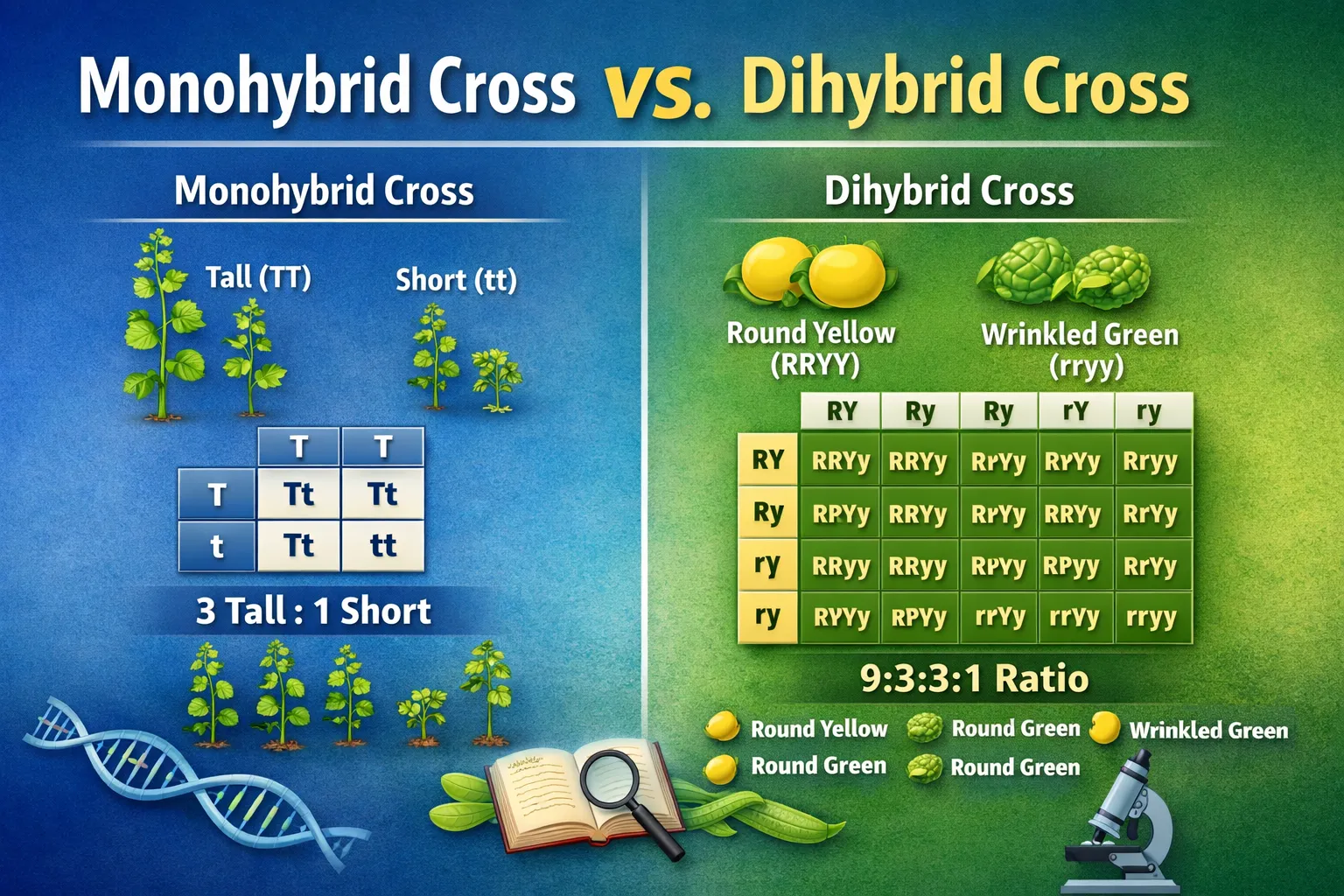
- Produces a typical phenotypic ratio of 3:1
- Helps understand dominant and recessive traits
Example of Monohybrid Cross
Gregor Mendel conducted experiments on pea plants to understand heredity. One famous example involves plant height.
Parent Generation (P Generation)
- Tall plant (TT)
- Short plant (tt)
Here:
- T = Dominant allele (Tall)
- t = Recessive allele (Short)
First Filial Generation (F1)
When TT is crossed with tt:
- All offspring become Tt
- All plants appear tall because the tall trait is dominant
Second Filial Generation (F2)
When F1 plants (Tt × Tt) are crossed:
| T | t | |
|---|---|---|
| T | TT | Tt |
| t | Tt | tt |
Results
- Genotype ratio = 1 TT : 2 Tt : 1 tt
- Phenotype ratio = 3 Tall : 1 Short
This ratio explains how traits segregate during reproduction.
What Is a Dihybrid Cross?
A dihybrid cross studies the inheritance of two traits simultaneously. It examines how two different genes are passed from parents to offspring and how they interact.
For example, Mendel studied pea seed shape and seed color together.
Simple Definition of Dihybrid Cross
A dihybrid cross is a genetic breeding experiment that analyzes the inheritance of two pairs of contrasting traits at the same time.
Key Features of a Dihybrid Cross
- Studies two different traits
- Demonstrates Mendel’s Law of Independent Assortment
- Uses larger Punnett squares
- Produces a typical phenotypic ratio of 9:3:3:1
- Shows how genes separate independently
Example of Dihybrid Cross
Mendel examined two characteristics of pea plants:
- Seed shape (Round or Wrinkled)
- Seed color (Yellow or Green)
Allele Representation
- R = Round (Dominant)
- r = Wrinkled (Recessive)
- Y = Yellow (Dominant)
- y = Green (Recessive)
Parent Generation (P Generation)
- RRYY (Round, Yellow)
- rryy (Wrinkled, Green)
First Filial Generation (F1)
When RRYY is crossed with rryy:
- All offspring become RrYy
- All seeds appear round and yellow
Second Filial Generation (F2)
Crossing F1 plants (RrYy × RrYy) produces four types of gametes:
- RY
- Ry
- rY
- ry
Using a Punnett square, the phenotypic ratio becomes:
- 9 Round Yellow
- 3 Round Green
- 3 Wrinkled Yellow
- 1 Wrinkled Green
Major Differences Between Monohybrid Cross and Dihybrid Cross
| Feature | Monohybrid Cross | Dihybrid Cross |
|---|---|---|
| Number of Traits | One trait | Two traits |
| Genetic Focus | Single gene inheritance | Two gene inheritance |
| Punnett Square Size | 2 × 2 | 4 × 4 |
| Mendelian Law | Law of Segregation | Law of Independent Assortment |
| Phenotypic Ratio | 3:1 | 9:3:3:1 |
| Complexity | Simple | More complex |
Mendel’s Laws Explained Through Crosses
Law of Segregation (Monohybrid Cross)
This law states that each organism has two alleles for a trait, and these alleles separate during gamete formation. Offspring receive one allele from each parent.
This principle is clearly observed in monohybrid cross experiments.
Law of Independent Assortment (Dihybrid Cross)
This law states that genes for different traits assort independently during gamete formation. It explains why combinations of traits appear in offspring.
Dihybrid crosses demonstrate how two traits can pass independently from parents to offspring.
Why Monohybrid and Dihybrid Crosses Are Important
These genetic crosses are fundamental for understanding heredity and variation. They help scientists, students, and breeders predict genetic outcomes accurately.
Applications in Real Life
1. Agriculture
Farmers use genetic crossing techniques to produce crops with better yield, disease resistance, and improved quality.
2. Animal Breeding
Breeders select desirable traits like size, strength, or milk production using genetic crossing knowledge.
3. Medical Genetics
Understanding gene inheritance helps researchers study genetic disorders and hereditary diseases.
4. Evolution Studies
These crosses explain how traits evolve and diversify in populations.
How to Solve Monohybrid Cross Problems Easily
Follow these steps:
- Identify dominant and recessive traits
- Assign allele symbols
- Determine parent genotypes
- Create Punnett square
- Calculate genotype and phenotype ratios
This simple method helps predict genetic inheritance accurately.
How to Solve Dihybrid Cross Problems Step by Step
Dihybrid crosses can feel complicated, but breaking them down helps.
Step 1: Identify Both Traits
Understand which traits are dominant and recessive.
Step 2: Determine Parental Genotypes
Write genotype combinations carefully.
Step 3: Identify Gamete Possibilities
Use the FOIL method to list gametes.
Step 4: Draw Punnett Square
Create a 4 × 4 grid for accurate results.
Step 5: Count Phenotype Ratios
Observe final genetic outcomes.
Common Mistakes Students Make
Avoiding these mistakes helps in learning genetics faster.
- Confusing genotype with phenotype
- Forgetting to separate alleles correctly
- Writing incorrect gamete combinations
- Ignoring Mendel’s laws
- Miscalculating phenotype ratios
Monohybrid vs Dihybrid Cross: Which Is Easier to Understand?
Monohybrid crosses are easier because they focus on only one trait. Dihybrid crosses involve two traits and require deeper understanding and larger Punnett squares.
Beginners usually learn monohybrid cross first before moving to dihybrid cross experiments.
Real-Life Examples of Genetic Crosses
Human Eye Color
Eye color inheritance can be studied using monohybrid crosses.
Blood Group Inheritance
Blood types demonstrate gene inheritance patterns.
Animal Coat Color
Breeders use dihybrid crosses to predict coat color and pattern combinations.
Why Gregor Mendel’s Work Still Matters Today
Gregor Mendel is known as the Father of Genetics because his experiments laid the foundation for modern genetic science. His research on pea plants helped scientists understand heredity, gene behavior, and trait inheritance.
Modern genetic research, biotechnology, and genetic engineering still rely on principles discovered through monohybrid and dihybrid crosses.
Frequently Asked Questions
What is the main difference between monohybrid and dihybrid cross?
A monohybrid cross studies one trait, while a dihybrid cross examines two traits simultaneously.
What ratio does a monohybrid cross produce?
A typical monohybrid cross produces a 3:1 phenotype ratio.
What ratio does a dihybrid cross produce?
A standard dihybrid cross produces a 9:3:3:1 phenotype ratio.
Why are Punnett squares important?
Punnett squares help predict possible genetic outcomes in offspring.
Final Thoughts
Monohybrid cross and dihybrid cross are essential tools for understanding genetic inheritance. They explain how traits pass from one generation to another and why offspring may differ from parents. While monohybrid crosses focus on single traits and are easier to learn, dihybrid crosses reveal more complex inheritance patterns involving multiple genes.
Mastering these concepts builds a strong foundation in genetics, helping students, researchers, and breeders predict hereditary traits accurately. These crosses continue to play a vital role in agriculture, medicine, and scientific research, proving how valuable Mendelian genetics remains in modern science.
Multipotent vs Pluripotent: Key Differences, Examples, and Why They Matter