Full Form DNA: Everything You Need to Know
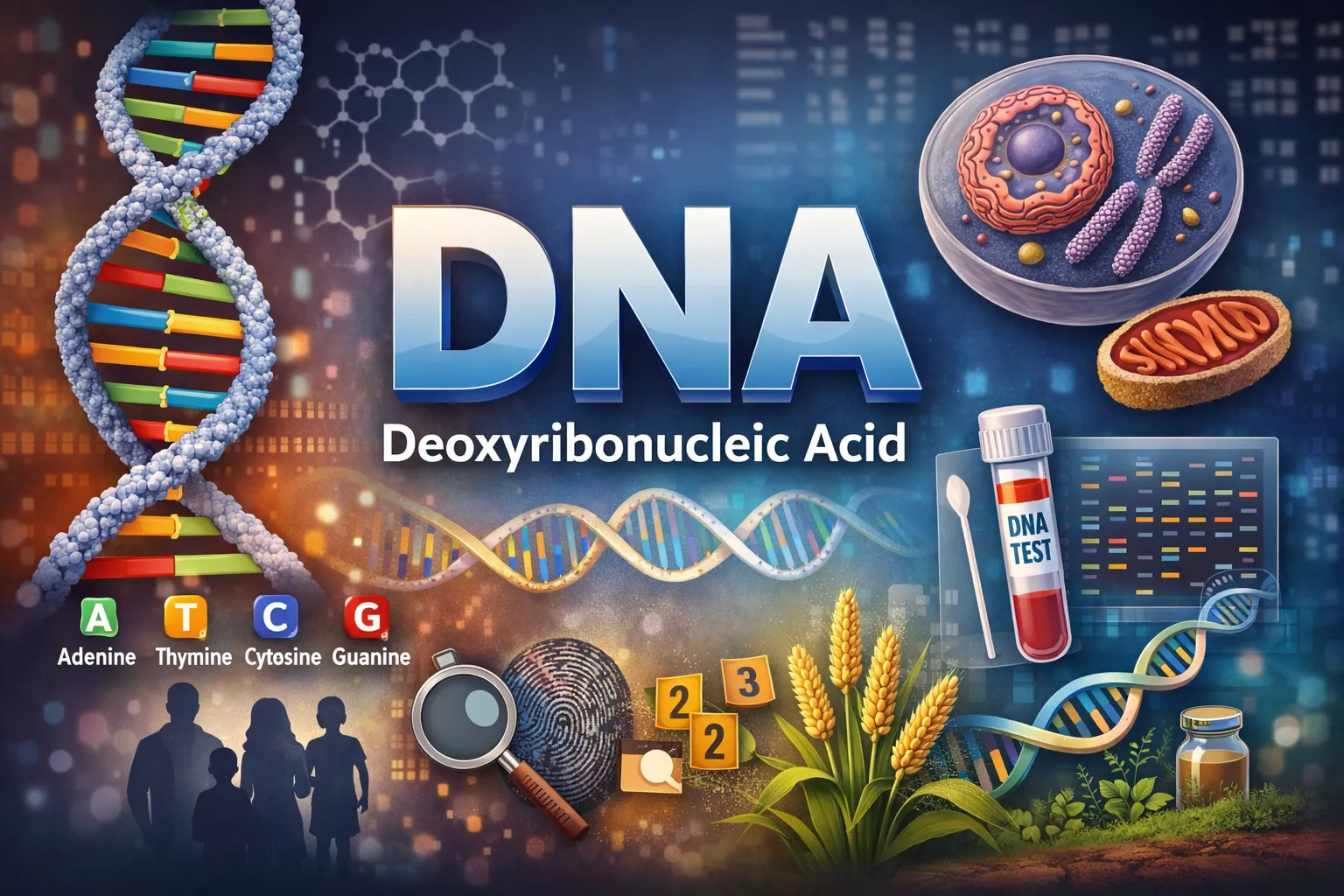
When it comes to understanding genetics, one of the first terms you’ll encounter is DNA. So, what is the full form of DNA? DNA stands for Deoxyribonucleic Acid, and it is the hereditary material in almost all living organisms. Simply put, DNA is like the instruction manual of life it carries the information needed to build, maintain, and replicate every cell in your body.
In this article, we’ll dive deep into the full form DNA, its structure, function, types, and why it’s so crucial in science, medicine, and everyday life. Whether you’re a student, science enthusiast, or just curious, this guide will answer all your questions about DNA in a simple and understandable way.
What Does DNA Mean?
The full form DNA is Deoxyribonucleic Acid, which might sound complex at first, but breaking it down helps:
- Deoxyribo – Refers to the sugar molecule called deoxyribose, which forms part of the DNA backbone.
- Nucleic – Indicates that DNA is found in the nucleus of cells.
- Acid – Because DNA molecules have acidic properties due to phosphate groups in their structure.
Put together, DNA is essentially a chain of nucleotides made of sugar, phosphate, and nitrogen bases, forming the blueprint for all biological life.
Structure of DNA
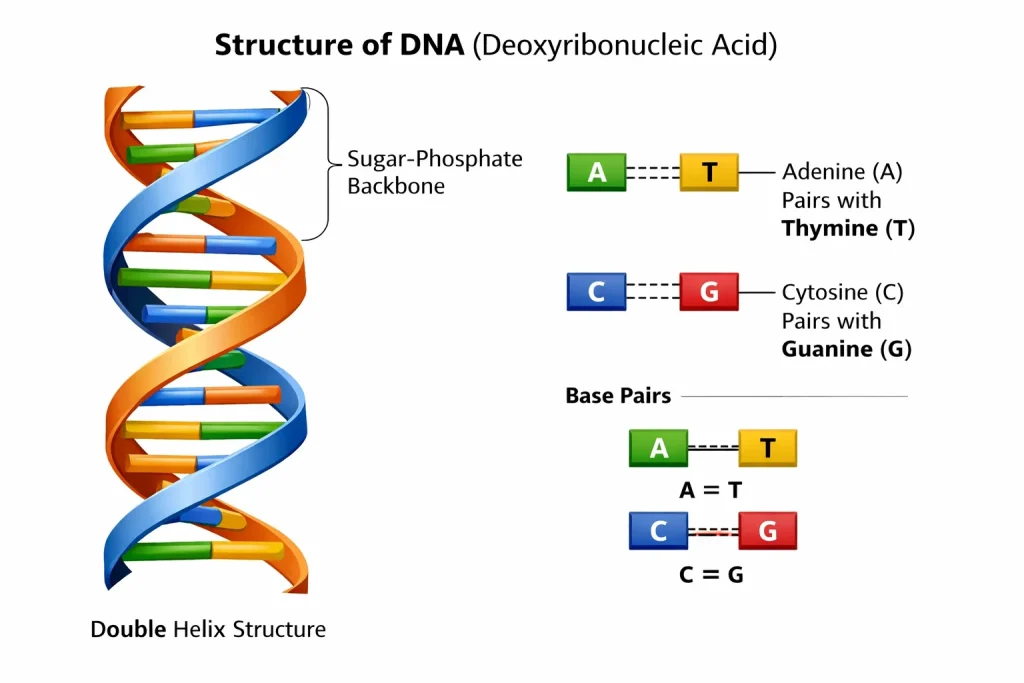
DNA is often depicted as a double helix, a term you might have seen in science textbooks or movies. This iconic shape was discovered by James Watson and Francis Crick in 1953.
Key Components:
- Sugar-Phosphate Backbone: This forms the sides of the DNA ladder, made of alternating sugar (deoxyribose) and phosphate molecules.
- Nitrogenous Bases: These are the “rungs” of the ladder and include four types:
- Adenine (A)
- Thymine (T)
- Cytosine (C)
- Guanine (G)
- Base Pairing Rules: A always pairs with T, and C pairs with G. This complementary pairing allows DNA to replicate accurately.
This structure is essential because it allows DNA to store vast amounts of genetic information compactly and transmit it reliably from one generation to the next.
Function of DNA
The main function of DNA is to store and transmit genetic information. But it does more than that:
- Genetic Blueprint: DNA contains instructions to build proteins, which perform almost all functions in your body.
- Cell Division and Growth: DNA ensures that when a cell divides, the new cells receive identical genetic information.
- Heredity: DNA is passed from parents to offspring, explaining why children inherit traits from their parents.
- Evolution and Mutation: Changes or mutations in DNA over generations can lead to evolution and species diversity.
Where Is DNA Found?
DNA is primarily located in the cell nucleus, but small amounts can also be found in mitochondria (called mitochondrial DNA). In humans, most DNA is found in 23 pairs of chromosomes in the nucleus, while mitochondrial DNA is inherited only from the mother.
Types of DNA
Understanding the types of DNA helps explain its versatility:
- Nuclear DNA: Found in the cell nucleus; responsible for most hereditary information.
- Mitochondrial DNA (mtDNA): Found in mitochondria; important for energy production and maternal lineage tracing.
- Circular DNA: Found in bacteria and some organelles; enables simpler organisms to replicate quickly.
Each type plays a vital role in life processes, from growth to energy production.
DNA in Everyday Life
DNA is not just a topic in biology class—it has real-world applications:
- Medical Diagnosis: DNA tests help identify genetic disorders like cystic fibrosis, sickle cell anemia, and more.
- Forensic Science: DNA profiling solves crimes and identifies missing persons.
- Ancestry and Genealogy: Services like 23andMe or AncestryDNA analyze your DNA to trace family history.
- Agriculture: DNA technology improves crop resistance and yields through genetic modification.
This shows how DNA is a central part of modern science, healthcare, and even daily life decisions.
Common Questions About DNA
Here are answers to some common queries people have when searching for full form DNA:
1. Is DNA only found in humans?
No, DNA exists in all living organisms, including plants, animals, fungi, bacteria, and even viruses (with slight differences).
2. How long is DNA?
If you stretched out the DNA in one human cell, it would be about 2 meters long amazing, considering it fits inside a microscopic nucleus!
3. Can DNA change?
Yes, DNA can mutate due to errors in replication or external factors like UV radiation. Some mutations are harmless, some beneficial, and some can cause diseases.
4. What is the difference between DNA and RNA?
While DNA stores genetic information, RNA helps convert that information into proteins. DNA is double-stranded, RNA is single-stranded, and DNA uses thymine while RNA uses uracil.
Interesting Facts About DNA
- The human genome contains around 3 billion base pairs.
- About 99.9% of DNA is the same in every human that tiny 0.1% difference makes each of us unique.
- DNA can survive thousands of years if preserved properly, which is why scientists can study ancient human remains.
- DNA is being used in futuristic technology like DNA computing and data storage because of its incredible density and stability.
How DNA Testing Works
DNA testing is becoming increasingly popular. Here’s a simplified explanation:
- Sample Collection: Usually saliva or cheek swab.
- Extraction: DNA is extracted from the cells.
- Amplification: Using a method called PCR (Polymerase Chain Reaction) to make millions of copies.
- Analysis: Sequencing or comparison against databases for ancestry, health risk, or forensic matches.
Why Understanding DNA Is Important
Knowing the full form DNA and its functions isn’t just academic it helps us:
- Understand genetic diseases and prevent them.
- Make informed decisions about ancestry and health.
- Improve agriculture, conservation, and biotechnology.
- Solve crimes and identify individuals with accuracy.
The study of DNA is a gateway to understanding life at its most fundamental level.
Conclusion
The full form of DNA is Deoxyribonucleic Acid, and it is the blueprint of life. From determining eye color to influencing complex diseases, DNA holds the secrets of biology and evolution. Understanding DNA allows us to advance in medicine, forensics, technology, and even genealogy.
Whether you’re studying biology, curious about your ancestry, or fascinated by forensic science, knowing what DNA is and how it works is essential. With its incredible structure, complex function, and wide-ranging applications, DNA truly is the code that shapes life as we know it.
Anion: Definition, Examples, Properties, and Real-Life Importance