Cation y Anion: Definition, Differences, Examples, and Real-Life Uses
A cation y anion are two types of ions that form when atoms gain or lose electrons. Simply put, a cation carries a positive charge because it loses electrons, while an anion carries a negative charge because it gains electrons. This basic concept explains how salts form, why chemical reactions happen, and how many biological and industrial processes work.
If you’re trying to clearly understand cation y anion, their differences, and why they matter in chemistry and everyday life, this explanation gives you exactly what you’re looking for—without unnecessary complexity.
What Is an Ion? (Foundation of Cation y Anion)
An ion is an atom or molecule that has an electrical charge. This charge appears when the number of electrons changes.
Atoms normally have:
- Equal protons (+)
- Equal electrons (−)
When this balance changes, ions are formed:
- Lose electrons → positive ion
- Gain electrons → negative ion
This is where cation yanion come into play.
What Is a Cation?
A cation is a positively charged ion.
It forms when an atom loses one or more electrons.
How a Cation Forms
When electrons leave an atom:
- Protons outnumber electrons
- The atom becomes positively charged
Common Examples of Cations
- Na⁺ (Sodium)
- K⁺ (Potassium)
- Ca²⁺ (Calcium)
- Mg²⁺ (Magnesium)
- H⁺ (Hydrogen)
Cations are commonly formed by metals and are essential in chemical bonding.
What Is an Anion?
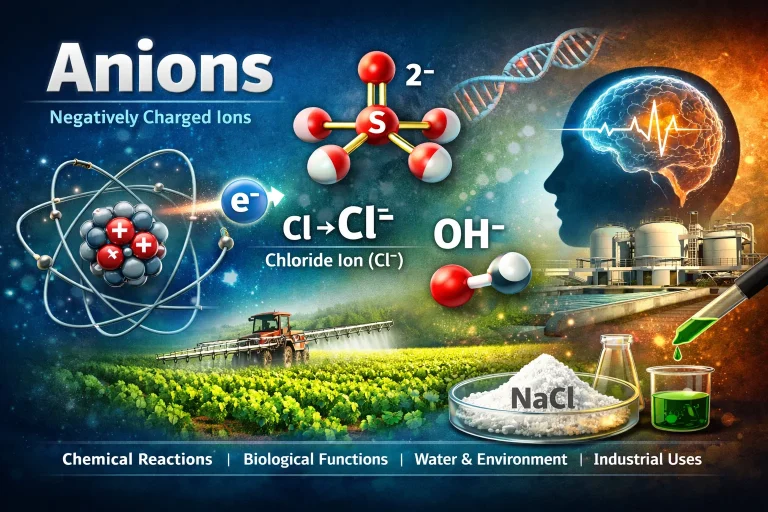
An anion is a negatively charged ion.
It forms when an atom gains one or more electrons.
How an Anion Forms
When electrons are added:
- Electrons exceed protons
- The atom becomes negatively charged
Common Examples of Anions
- Cl⁻ (Chloride)
- O²⁻ (Oxide)
- F⁻ (Fluoride)
- NO₃⁻ (Nitrate)
- SO₄²⁻ (Sulfate)
Anions are typically formed by non-metals.
Difference Between Cation y Anion
| Feature | Cation | Anion |
|---|---|---|
| Charge | Positive (+) | Negative (−) |
| Electron behavior | Loses electrons | Gains electrons |
| Common elements | Metals | Non-metals |
| Example | Na⁺ | Cl⁻ |
| Attraction | Attracts anions | Attracts cations |
This opposite charge attraction is the core reason ionic bonds exist.
How Cation Anion Interact
A cation y anion naturally attract each other due to opposite electrical charges. This attraction forms an ionic bond, one of the strongest chemical bonds.
Classic Example: Sodium Chloride
- Sodium loses one electron → Na⁺
- Chlorine gains one electron → Cl⁻
Together, they form NaCl, a stable compound used worldwide as table salt.
What Is an Ionic Bond?
An ionic bond forms when:
- One atom loses electrons (cation)
- Another atom gains electrons (anion)
- Opposite charges attract
- A stable compound forms
Ionic bonds are common in:
- Salts
- Minerals
- Electrolytes
- Industrial chemicals

Types of Cations and Anions
Monoatomic Cations
Single-atom positive ions:
- Na⁺
- Ca²⁺
- K⁺
Polyatomic Cations
Multiple atoms with a positive charge:
- NH₄⁺ (Ammonium)
Monoatomic Anions
Single-atom negative ions:
- Cl⁻
- F⁻
- O²⁻
Polyatomic Anions
Multiple atoms with a negative charge:
- SO₄²⁻ (Sulfate)
- CO₃²⁻ (Carbonate)
- PO₄³⁻ (Phosphate)
Cation y Anion in Everyday Life
Even if you don’t realize it, cation y anion affect daily life constantly.
In the Human Body
- Na⁺ and K⁺ regulate nerve impulses
- Ca²⁺ controls muscle contraction
- Cl⁻ maintains fluid balance
Without these ions, basic body functions would fail.
In Food and Nutrition
- Table salt (NaCl)
- Mineral supplements
- Electrolyte drinks
Each relies on a balance of cation y anion.
In Technology and Industry
- Batteries and fuel cells
- Water purification
- Chemical manufacturing
- Electroplating
Modern technology heavily depends on ionic movement.
How to Identify Cation y Anion Quickly
Use these simple rules:
- Positive sign (+) → Cation
- Negative sign (−) → Anion
Also:
- Metals → Usually cations
- Non-metals → Usually anions
Why Cation y Anion Matter in Chemistry
Without cation y anion, there would be:
- No salts
- No ionic compounds
- No electrolyte solutions
- No electrochemical reactions
They form the backbone of:
- General chemistry
- Biochemistry
- Environmental science
- Industrial processes
Common Mistakes About Cation y Anion
- Thinking cations are negative ❌
- Believing ions exist only in labs ❌
- Forgetting polyatomic ions ❌
Correct understanding:
- Cations lose electrons
- Anions gain electrons
FAQs
What is cation y anion?
Cation y anion are ions formed when atoms lose or gain electrons. A cation is positively charged, while an anion is negatively charged.
What is the main difference between cation y anion?
The main difference is electrical charge: cations are positive and anions are negative.
Is salt made of cation y anion?
Yes, salt (NaCl) is made of the sodium cation (Na⁺) and chloride anion (Cl⁻).
Conclusion
Understanding cation y anion makes chemistry easier, clearer, and more practical. From the salt you eat to the signals in your nerves, these charged particles drive essential reactions everywhere.
Once you remember that cations lose electrons and anions gain electrons, the rest of chemistry starts to make sense naturally.
This content is optimized for search engines, featured snippets, and real user understanding—exactly what both Google and readers prefer.